THAAD row depicts China's double standard
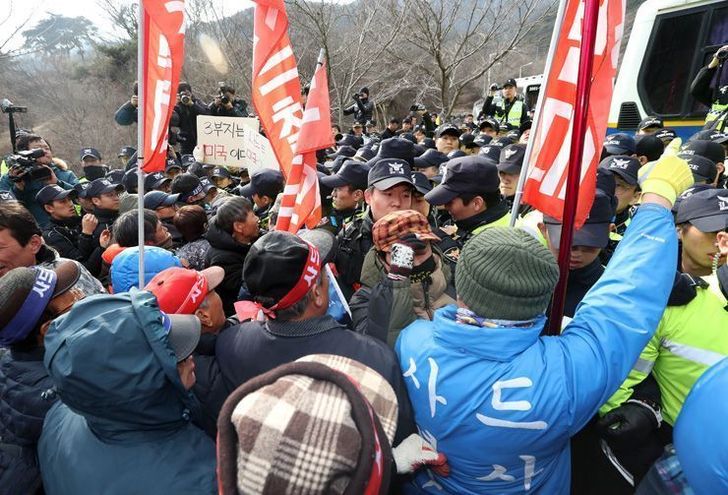
Riot police confront protesters during a rally in Seongju, North Gyeongsang Province, Wednesday, against the planned deployment of a U.S. Terminal High Altitude Area Defense (THAAD) battery there. The first batch of the THAAD components arrived here, Monday. / Yonhap
By Yi Whan-woo
China is intensifying retaliation against South Korea over Seoul’s decision to deploy a U.S. Terminal High Altitude Area Defense (THAAD) battery, while maintaining a dubious stance on North Korea’s nuclear and missile tests, analysts said Wednesday.
Beijing’s “two-faced” policy toward the two Koreas is evident in the current row over the deployment of the THAAD system here.
The analysts said China’s retaliation is ultimately intended to show off its power in the region to U.S. President Donald Trump’s administration and that Seoul should be ready to better cope with Chinese policies depending on Washington-Beijing relations.
Regarding North Korea, China apparently has been reluctant to fully exercise leverage on the isolated regime in line with South Korea’s calls. Yet it has been infuriated over Seoul’s decision to host a THAAD battery aimed at deterring Pyongyang’s ballistic missile threats, according to experts.
They said Beijing also has been dubious in its policy against trade protectionism — Chinese President Xi Jinping warned President Trump over tariffs and other protectionist measures the latter talked about, while at the same time Beijing instigated an apparent ban on South Korean businesses and their products in retaliation to the deployment.
China appears to be self-contradictory as well in picking on South Korea instead of the U.S., considering its argument that the THAAD deployment is a part of the U.S. strategy to build a missile defense system encompassing the Korean Peninsula and contain a rising China.
Concerning THAAD’s X-Band radar, China has protested that the long-range radar can be used to spy on its military activities. Yet, it already operates radars that keep the whole peninsula under surveillance and also has up to 500 missiles that can target South Korea, according to the analysts.
Against this backdrop, Chinese Foreign Minister Wang Yi held the two Koreas and the U.S. responsible for diplomatic conflicts surrounding the peninsula but did not mention Beijing’s role, Wednesday.
During a live televised press conference at the annual National People’s Congress in Beijing, Wang said North Korea on the one side, and South Korea and the U.S. on the other should “stop being on a collision course against each other.”
He asked North Korea to stop ballistic missile tests while urging South Korea and the U.S. to stop their annual military exercises to deter Pyongyang’s military threats.
Concerning the 25th anniversary of Seoul-Beijing relations, Wang said he deems it “very precious” and that the mutual interests of the two neighbors should be maintained. However, he reiterated Beijing’s opposition toward THAAD, saying that its deployment “puts Korea’s national security at a higher risk.”
“It has become so apparent that South Korea and China have a discrepancy in their strategic interests and North Korea-related issues,” said Park Won-gon, an international relations professor at Handong Global University.
Yang Moo-jin, a professor at the University of North Korean Studies, said “The course of Seoul-Beijing relations will depend on the outcome of their row over THAAD.”
Park said South Korea should develop a strategy to prepare for China’s diplomatic polices in line with Beijing’s ties with Washington.
“It seems Beijing picked on Seoul over Washington concerning the THAAD dispute because the Trump administration is still underway in shaping its China policy and Beijing probably wanted to wait for a while before taking relevant action against Washington,”he said.
“We should keep China’s diplomatic duplicity in mind and come up with measures accordingly depending on how U.S.-China relations develop.”