STEM or bust? Korea’s future at risk as top students avoid engineering
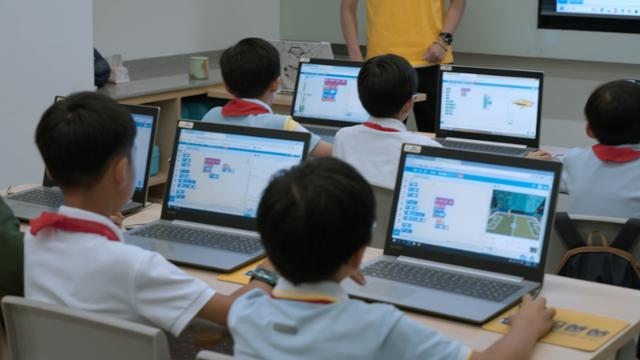
Chinese elementary school students attend a computer programming class. Captured from KBS
A powerful two-part KBS documentary contrasting South Korea’s obsession with medical school and China’s strategic push for science and engineering talent has struck a nerve, drawing millions of views, impassioned viewer reactions and calls for systemic change.
The documentary, titled “Docu Insight — The Talent War,” aired last month and surpassed 970,000 views on YouTube within three weeks of its release. One viewer’s comment, “They should play this during a Cabinet meeting and make the president, prime minister and ministers each write a 10-page book report,” captured the urgency many felt after watching.
Public reactions ranged from shock to despair: “I had no idea things were this bad for STEM,” “The future is terrifying,” and “It’s heartbreaking that our brightest minds only chase money.” In response to the surge in attention, KBS hastily aired a live panel discussion on July 27 focused on fostering talent in science and engineering.
On July 30, Hankook Ilbo met with producers Jung Yong-jae, Lee I-baek and Shin Eun-joo at the KBS headquarters in Yeongdeungpo District, Seoul. The trio said they were overwhelmed by the unexpected buzz but hoped the discourse would go beyond surface-level reactions.
Why China, and why now?
Tsinghua University professor Andrew Yao / Captured from KBS
The first episode, titled “China, Obsessed with Engineering,” showcases a nation where engineering prodigies are treated as national heroes. The project was sparked by the “DeepSeek shock” earlier this year, when Chinese artificial intelligence startup DeepSeek stunned the world with a high-efficiency inference model built using only low-cost chips. That breakthrough prompted the producers to contrast China’s soaring science capabilities with Korea’s intense rush toward medical schools.
“I had read many reports about China’s national strategy and talent system, but I wondered how much of it was real,” said Jung. “We felt we had to go there and see it ourselves.”
Getting footage from within China’s high-tech industries, however, was nearly impossible. It took two months of near-constant rejections just to arrange interviews, and the team struggled to obtain filming visas up to the last minute. Yet they persisted, eventually securing rare interviews with leaders of Hangzhou’s six most-watched startups, Turing Award-winning Tsinghua University professor Andrew Yao and even a veteran Korean scientist who left for China. According to Jung, this marks the first time since KBS made their “Super China” documentary in 2015 that a Korean broadcaster has obtained full legal permission to film such content in China.
Engineering vs. medicine — a false choice?
A scene from KBS documentary "Docu Insight" / Courtesy of KBS
The second episode, “Korea, Obsessed with Medical School,” explores why Korea’s top students overwhelmingly flock to medicine. Interviewing more than 50 aspiring doctors, the producers found a common thread: fear. Many cited job security and social status as driving forces behind their decision, not passion for science or health care.
Lee emphasized that the documentary does not aim to vilify individuals. “It’s not fair to say that going into engineering is noble while choosing medicine is wrong. People are making the best decisions they can based on anxiety and the system around them,” she said.
Shin added that while the title includes “Korea, Obsessed with Medical School,” many viewers wondered why no doctors appeared on screen. “We interviewed and filmed some, but due to the sensitivity of the topic, everyone requested voice distortion and face blurring. We felt including them might lead to unnecessary finger-pointing.”
No answers — just a mirror
From left, producers Jung Yong-jae, Lee I-baek and Shin Eun-joo respond to questions during an interview at KBS headquarters in Yeongdeungpo District, Seoul, on July 30. Courtesy of KBS
The documentary does not offer simple solutions. As Seoul National University professor Lee Jeong-dong says in the film, “A nation with technology survives. One without it does not. We must use every card we have.” The producers agree that policy-level support for STEM talent is urgent, but say it’s now up to viewers — and leaders — to carry the conversation forward.
“We’ve done our job as journalists by creating space for public discourse and sparking national interest,” said Jung. “Now it’s time for policymakers to take action and deliver real-world changes.”
Lee added, “Right now in Korea, kids are burning out on exams from a young age and gravitating toward safe outcomes. We need to build a society where choosing something new isn’t punished — where curiosity and passion are allowed to flourish.”
This article from the Hankook Ilbo, the sister publication of The Korea Times, is translated by a generative AI system and edited by The Korea Times.