Korea's debt ratio isn't yet worrisome: S&P
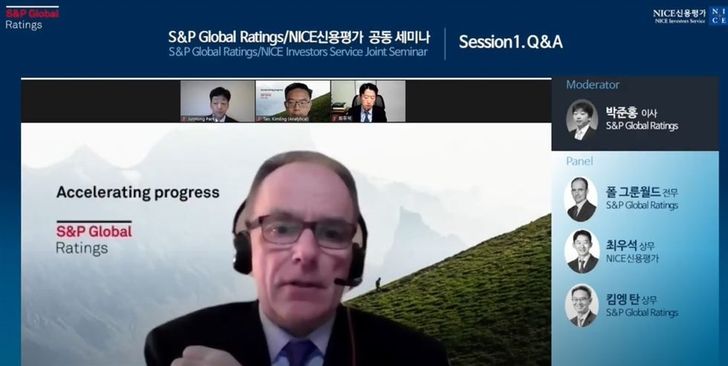
S&P Global Ratings' Global Chief Economist Paul Gruenwald speaks during an online seminar jointly hosted by S&P Global Ratings and NICE Investors Service. Screenshot from during the seminar
By Anna J. Park
Global ratings firm S&P said that Korea's debt level is not yet worrisome enough to exert a negative influence on the country's credit rating.
During an online seminar jointly held by S&P Global Ratings and NICE Investors Service on Thursday, S&P's Senior Director Kim Eng Tan, who is in charge of Asia-Pacific sovereign ratings, said Korea will not be negatively affected by the current debt level in the foreseeable future.
“Korea's spending remains at a modest level in comparison with other countries, given that most countries' debt levels have been significantly increased during the global pandemic,” Tan said during the seminar.
The senior analyst explained that S&P estimated that Korea's debt level is slightly more than 40 percent of the GDP, when the figures are adjusted according to S&P's criteria. Yet, when considering the country's ample liquidity assets, including the National Pension Service's substantial holdings of Korean bonds, Korea's net debt ratio is estimated to be around 15 percent of the national GDP.
“If Korea's net debt level doubles from the current level, then it could negatively impact the sovereign credit rating. Another reason that the current debt amount is not likely to affect ratings is that Korea's economic policy environment is very strong,” he explained.
However, the senior analyst added that this situation does not mean that Korea doesn't need to worry about its fiscal status. He said that the economy's rapidly aging population, as well as the country's exposure to the geopolitical risks of the North Korean regime, are still factors that weigh on the economy. However, he stressed that it's not likely that Korea will be negatively impacted by impaired sovereign ratings due to the debt ratio in the near future.
Regarding the country's economic growth forecast in 2022, S&P Global Ratings' Global Chief Economist Paul Gruenwald expects the Korean economy to grow by 2.8 percent next year, 0.2 percentage points lower than its previous forecast, yet he explained that it does not amount to a big revision.
The Bank of Korea's increase of its key interest rates, as well as neighboring economies like China and Japan's slightly lower forecasts for 2022, are all factors that have jointly influenced the revision of the country's forecast, he said.
By industry sector, S&P expects that a favorable business environment will continue next year, particularly for export-driven manufacturing enterprises. S&P credit analyst Park Jun-hong explained that the semiconductor, automobile, electronics manufacturing and steelmaking sectors are expected to continue enjoying stable business growth during the next year, based on their solid operational profits this year. He also expected more Korean conglomerates to diversify their business portfolios aligning with ESG management principles in the near future.