Kyobo Life celebrates 60th anniversary
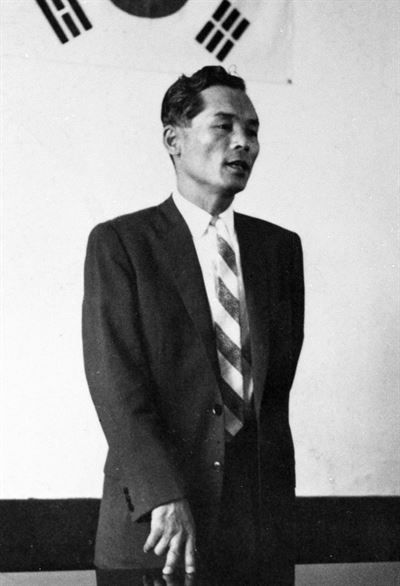
Kyobo Life Insurance founder Shin Yong-ho speaks during the company's foundation ceremony at its head office in central Seoul, Aug. 7, 1958. / Courtesy of Kyobo Life Insurance
By Jhoo Dong-chan
Kyobo Life Insurance marked its 60th anniversary, Tuesday.
Founder Shin Yong-ho started the insurance firm with total assets of only 22 million won ($19,547) in 1958.
The firm has grown to become one of the nation's life insurance giants with combined assets of over 100 trillion won. It has 4.3 million policyholders with 8.5 million contracts now.
“Don't be so sad about our humble inauguration,” Shin said during the firm's foundation ceremony at its office in Jongno-gu, central Seoul, Aug. 7, 1958.
“It takes at least 50 years even for an insurance firm in a developed country to establish its foothold in the market. I will make Kyobo become one of the top global insurance companies within 25 years. We will also have a huge skyscraper in central Seoul by then.”
Under Shin's leadership, Kyobo managed to build the Kyobo Building, an iconic landmark in downtown Seoul, in 1980, and then won the International Insurance Society (IIS) award three years later.
The IIS is a global forum for all insurance industry stakeholders, probing vital issues and utilizing research works to help drive the industry's growth and innovation.
The head office of Kyobo Life in Jongno-gu in 1958 / Courtesy of Kyobo Life Insurance
A Kyobo official said Shin founded the firm to help educate young Koreans based on his belief that they will rebuild the country from the ashes of the Korean War.
Unlike other insurance firms, Kyobo has introduced a series of education insurance products to provide youngsters more learning opportunities.
Thanks to the firm's education insurance, about 3 million students have received scholar benefits for 30 years. And they have become the founding stone of Korea's miraculous economic growth in the 1960s and 1970s.
Due to booming popularity in the firm's education insurance, Kyobo became the nation' largest insurance company in capital in 1967.
IMF Crisis
Despite its three decade-long success in the industry, the 1997 IMF crisis was a huge hurdle for the company. Kyobo sustained estimated losses of 2 trillion won in 1997 as its partner firms went out of business one by one, bitten by the credit crunch.
Following turbulent periods, founder Shin's son Shin Chang-jae, current chairman and CEO, took the helm of Kyobo in 2000 when the insurer still suffered a 254 billion loss.
He brought a major turnaround for the insurer by shifting the focus to sustainability from sales.
Claiming “sales ranking is not important anymore,” he emphasized the firm's sustainability and internal stability over external growth.
Under the new CEO's leadership, Kyobo started focusing on long-term insurance contracts while renovating its management and productivity.
Since the second-generation CEO came to the post, Kyobo has enjoyed handsome profits of around 500-600 billion won every year.
The firm's risk-based capital ratio, the ratio of total capital against risk-weighted assets, stood at 277.6 percent as of March 2018, the highest among local insurers. It is a barometer to measure an insurance company's financial soundness.
In terms of return on equity, Kyobo has also been the highest among the nation's insurance firms since 2004.
The new Kyobo Life Insurance variable education insurance
New variable education insurance
Celebrating the firm's 60th anniversary, Kyobo introduced a new variable education insurance.
In a bid to ease burden of the nation's college tuition, Kyobo said it invests in equity stocks and bonds with policyholders' premiums to provide them consequential profits as educational funds.
“The insurance product obviously will promise policyholders more returns if investments are good. Even if investments aren't good enough, the product guarantees up to a 135 percent return with policyholders,” said a Kyobo Life Insurance official said.
The new variable educational insurance product can be used as children's future education funds or can be shifted to parents' retirement savings, the official added.