Soaring eating-out costs weigh on households
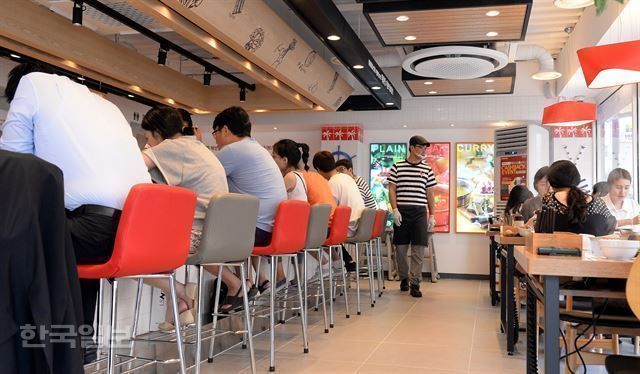
Customers have lunch at a restaurant in Daehangno, Seoul, in this file photo. As many restaurants have raised prices following the minimum wage hike, salaried workers are refraining from eating out for lunch. / Korea Times photo by Bae Woo-han
By Yoon Ja-young
Kang, an office worker in Gangnam, southern Seoul, has been refraining from eating out for lunch. He instead goes to the company cafeteria.
“I often had samgyetang, or ginseng chicken soup, in summer, but now it costs around 14,000 won per bowl. I was surprised to see an omelet with rice priced at 13,000 won at a casual restaurant. It is difficult to find dishes that are priced below 10,000 won near my office,” he said.
As eating out expenses are rising following the minimum wage hike and soaring prices of agricultural produce, consumers are complaining that they are losing purchasing power despite their pay raise.
According to “Cost of living in cities around the world, Prices and Earnings 2018” by UBS, Seoul is the third most expensive city in terms of food prices, with only Geneva and Zurich, both in Switzerland, costing more than Seoul. Even Tokyo, which was once notorious for its high cost of living, trailed after Seoul.
While food is expensive in Geneva and Zurich, the workers in those two cities also had huge earnings, ranking first and second in the world. The earnings of Seoulites, meanwhile, ranked at 38th, and their purchasing power also stood at 38th. It means it is tougher for average workers to survive in Seoul.
Restaurants are raising prices citing the higher minimum wage as well as soaring prices for fresh foods. The country's minimum wage was raised by 16.4 percent this year, and it is set to rise by 10.9 percent next year as the administration wants to increase the income of households to boost consumption.
“You will see prices rising everywhere. Restaurant owners should raise prices on their menus as they have to pay more to their employees, and those who are hired by others will need higher pay as they cannot afford to eat out following the hike,” said Oh Jung-geun, a professor at Konkuk University.
According to the Korea Consumer Agency, average prices of naengmyeon, or cold buckwheat noodles, which became famous after being served at the summit between President Moon Jae-in and North Korean leader Kim Jong-un, recorded 8,808 won in restaurants in Seoul last month, up 10.6 percent from a year ago.
Prices of samgyeopsal, or grilled pork belly, also rose 5.6 percent to 16,489 won from 15.621 won during the one year period.
As a result, more workers are heading to cafeterias operated by their company or bringing their lunch to work. According to a survey by Job Korea, a job market information provider, the ratio of workers who have lunch at company cafeterias marked 36.8 percent, up 3.2 percentage points from a year ago. Those who brought their lunch from home marked 8.3 percent, while 7.8 percent said they buy lunch from convenience stores.