Banks scrambling to cope with work hour reduction
By Kim Yoo-chul
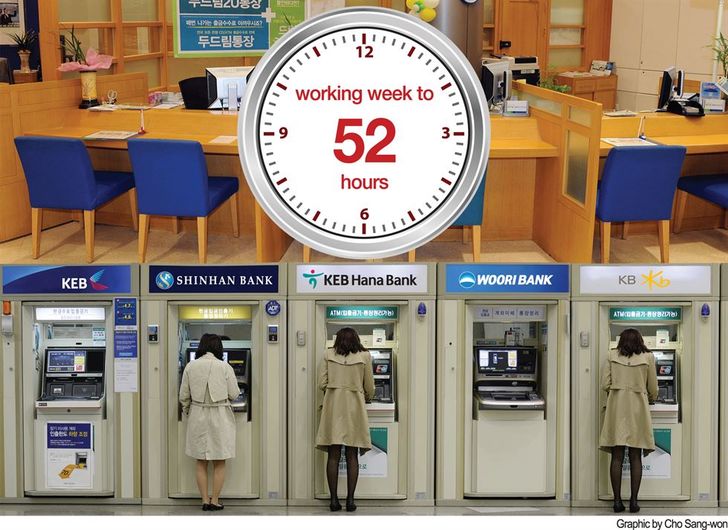
Commercial lenders are scrambling to prepare for a reduction in working hours, with KB Kookmin, Industrial Bank of Korea (IBK) and KEB Hana setting up taskforces.
The National Assembly Environment and Labor Committee approved a bill recently that cuts the maximum statutory working hours from 68 to 52, with support from both the governing and opposition parties. The law comes into force in July and will apply to large firms before being rolled out to smaller businesses.
Slashing working hours was a “central campaign promise” of President Moon Jae-in. With hours cut, businesses will need to spend up to $11 billion each year to keep up with production, according to the Korea Economic Research Institute (KERI), a local think tank.
But the lenders have no “big objections” to the initiative, as its purpose is aimed at improving quality of life and boosting employment.
“The bill mandates the IBK introduce the 52-hour workweek next year, but upon agreement with the bank's union, it plans to introduce the system this July,” a bank official said. He added that the IBK has been operating a taskforce since March.
“Introducing a PC-Off system will automatically be applied to employees who exceed the maximum statutory weekly working hours. The IBK is also considering offering more flexible working hours systems. Employees will be allowed to start their working day anytime between 7:30 a.m. and 11 a.m.,” the official said.
Trial tests will be completed by the end of June and the bank plans to officially launch the new working hour policy with updates in the latter half of the year.
Shinhan Bank said it was in discussions with its union to explore measures that would fit with the new working hours.
“What to add or drop is the main point. But one thing is employees will no longer perform tasks that are unnecessary. As the bank is on track to upgrade systems due to the extreme need for digitalization of banking systems, we plan to allocate more capital and human resources for greater efficiency,” a Shinhan Bank official said.
KEB Hana Bank said its taskforce has been collecting data from business units to analyze their employees for signs of stress from overtime work and other issues that could affect their workplace performance.
“When an issue is detected, workers in question will be told to take additional benefits or reassigned to a less challenging job. The bank plans to apply updated measures unit-by-unit,” a KEB Hana official said.
KB Kookmin and Woori Bank also said they are planning to find ways to increase worker efficiency. One of the examples being studied is adjusting the length and number of breaks to be more in sync with their employees' individual needs.
“There was no discord between management and the union for an early introduction of the new working hours, while the system can't be effective in all branches and business units due to the unique differentiation of given tasks and roles,” said Kim Tae-young, head of the Korea Federation of Banks.