Bank of Korea in dilemma over interest rate hike
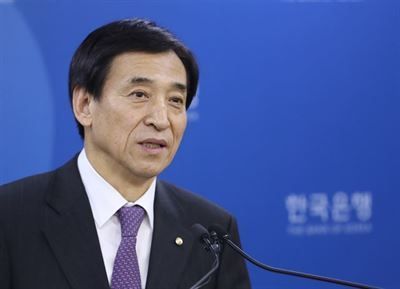
Bank of Korea Governor Lee Ju-yeol
By Jhoo Dong-chan
The Bank of Korea (BOK) has been in a dilemma over whether or not to raise its key interest rate, as its U.S. counterpart will continue to make it more expensive to borrow money.
Since raising the rate to a range of 1.25 percent to 1.5 percent last November, the central bank has been considering hiking the rate further, as the Federal Reserve increased its benchmark by a quarter of a percentage point in March to a range of 1.5 percent to 1.75 percent, resulting in a rate reversal in the world’s largest economy and Korea.
The BOK fears this rate reversal may prompt foreign investors to take money out of Korea and bring it to the United States or other advanced nations, particularly when the global financial market destabilizes.
This prevailing concern has amplified in recent weeks as Argentina, Indonesia, Turkey and other emerging economies have seen the value of their currencies plunge as international investors flee to advanced markets.
However, the central bank has remained reluctant to hike the key rate amid the deteriorating job market, falling consumption and other unfavorable economic conditions.
In particular, record-high household debts have been weighing heavily on the BOK, making most domestic and international analysts believe it won’t likely raise the benchmark lending rate anytime soon.
“The Bank of Korea will likely keep the policy rate unchanged at 1.5 percent this month, taking a wait-and-see approach. With inflation still below the central bank’s 2 percent target and the labor market showing signs of weakness, we expect monetary policy to stay on hold,” Moody’s Analytics said.
“Two factors keeping a lid on price pressure are the elevated won and the softening labor market.”
Goldman Sachs has revised its previous forecast of the key rate hike in July into October. Some market researchers even claim the nation’s key rate will maintain its current level this year.
“Financial stability in emerging economies is coming under question while Korea’s job market is getting worse. I don’t think the BOK will raise the key rate in the first half of this year,” LG Economic Research Institute researcher Cho Young-moo said.
“It won’t be easy to settle these factors even in the second half, but the BOK wants to raise the rate when conditions are right. The decision depends on the nation’s economy in the second half. If the nation’s employment rate and emerging economies improve, the BOK will raise the key rate in the third quarter.”
BOK Governor Lee Ju-yeol said last week the BOK will consider hiking the policy rate when “various conditions match up,” but is now likely to stick to the present level of 1.5 percent at its upcoming monetary meeting next week due to prevailing uncertainties raised here and abroad.
“There are a number of unfavorable factors at home and abroad. I do not think it’s time to stay optimistic,” Lee said. “Uncertainties are prevailing since major economies are normalizing their monetary policies while there are ongoing trade tensions between the U.S. and China. Emerging economies are also experiencing difficulties in restoring their financial stability. Korea’s high unemployment rate is also another worrying development,” he said.
According to the New York Stock Exchange Bonds, the interest rate of the 10-year U.S. Treasury bonds has recently reached its highest in seven years while the Brent crude oil broke $80 per barrel.
The factors are raising emerging economies’ dollar bonds while slowing down the investment inflow into those countries.
Korea’s unemployment rate has also failed to improve for months.
Employment growth still hovered below 200,000 for the third straight month, with jobless rate staying unchanged at 4.1 percent, according to the government report this week. It is the first time since the 2008 global financial crisis that the economy’s job creation growth stayed below 200,000 for three months in a row.
“Despite all these, the BOK is still under pressure to consider raising the policy rate for various reasons,” an NH Nonghyup official said.
“Now the U.S. interest rate is higher than the nation’s rate. The U.S. Treasury said it will raise it once again next month. Then, the gap will be even wider. Domestically, the government has also tightened the mortgage loans. Now people get loan on credit with higher interest rates. This could be another bad omen,” the official said.