Embrace AI or be wiped out
By Park Hyong-ki
Everywhere people go, artificial intelligence (AI) seems to be the keyword.
On the news, television talk shows, in books and over dinner tables, AI is a hot topic.
Even at U.S. college graduation ceremonies over the past few weeks, AI has been the main theme.
Kai-Fu Lee, a Taiwanese venture capitalist, urged Columbia University graduates "not to miss out, but embrace the age of AI.”
He told them to align their career goals with the inevitability of the growth of AI.
Microsoft founder Bill Gates advised college students to pursue careers related to AI because that field would offer “phenomenal and exciting” opportunities.
Whether people like it or not, AI is about to come on really fast and reshape the global economy.
It will take over jobs from doctors, accountants, journalists, construction workers, social workers, corporate middle managers and even executives. If robots get wiser, they will make cost-efficient decisions by crunching massive amounts of data in seconds.
Through books and current affairs talk shows, scholars, economists and scientists challenge readers and audiences to envision a future where robots can do most of the work people now do not only at lower costs but also with perfect precision and timing.
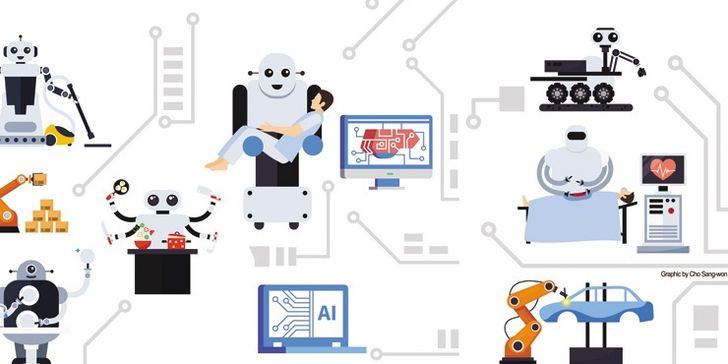
The world is already seeing robots building bridges, performing medical procedures, inspecting disaster zones and even writing news articles and screenplays.
As AI becomes more intelligent, will this world ruled by Homo sapiens come to an end? Yuval Noah Harari’s books “Sapiens” and “Homo Deus” certainly provoke readers to think of this possibility.
After all, humans were able to conquer, pollute and enrich this planet as soon as they learned the skills to talk, write, calculate, document and trade as they expanded their turf. Robots, even at their nascent stage of development, have already begun to take those steps.
Sun Dae-in, a local economist, forecast in his book “The Future of Jobs” that the labor market looks dim amid an aging population, low birthrate and AI, urging the next generation to take up new skills that cannot be matched by robots.
So the question is what is Korea doing to prepare for this new world? Is the education system aligned with this future? Is the private sector aware what’s coming?
From various books, interviews, news and data, Koreans, in general, seem “nonchalant.”
There is definitely a gap in the urgency and importance of AI between the Western world and this country, even between it and China and Southeast Asian economies where innovation is rapid.
Korea lags far behind in AI development. It has the lowest number of AI startups, scholars and engineers. Also, it has the lowest amount of investment being made in the field compared to the United States, Europe, China and Japan, according to the National Information Society Agency.
When AI becomes the mainstream, it will be nothing like smartphones. And Korea will not be able to hold it off like it did with Apple’s iPhone in 2007 to give some leeway for local players to catch up.
AI does not have any boundaries to extending its reach. The more one resists AI, the more it will be disruptive and chaotic.
Korea needs to embrace AI and be seriously prepared for this new age of intelligence and automation.
Lee said AI can help people grow and find “treasure.” Otherwise, be prepared to be wiped out.