IFEZ eyes leadership as smart city hub
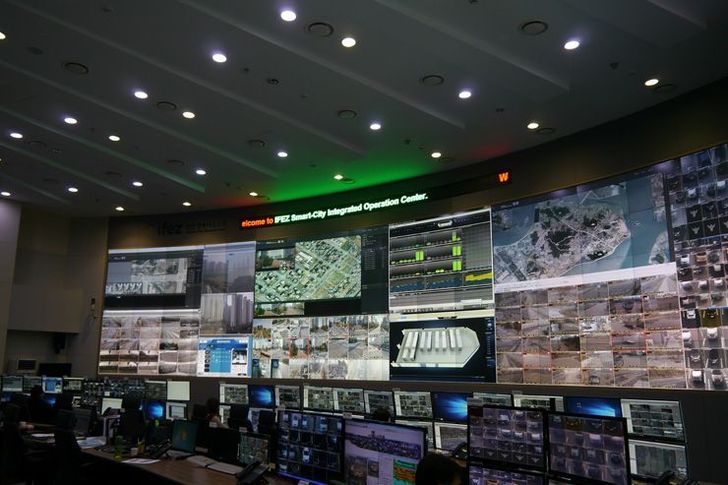
Seen in this photo is the Incheon Free Economic Zone (IFEZ) operation center which opened last month. IFEZ expects the smart international hub to become Asia’s largest investment hub. / Courtesy of IFEZ
By Lee Min-hyung
Incheon Free Economic Zone (IFEZ) is gaining attention as Asia’s leading smart hub combined with advanced internet of things (IoT) technologies.
With an IFEZ operation center opening in April in the nation’s northwestern city of Incheon, expectations are the facility will boost the city’s aggressive bid to turn the hub into an exemplary and state-of-the-art info-tech service provider, IFEZ said Monday.
At the center of the service is CCTV set up at three major regions in Incheon — including Songdo, Yeongjong Island and Cheongna — designated as parts of IFEZ.
The IFEZ operation center collects information via CCTV, offering smart services in such areas as traffic, security and commerce. IFEZ explains the collected datasets will be processed in real time on its cloud platform.
To be specific, the smart economic hub will establish bus information terminals in multiple languages, allowing not just locals, but foreign visitors to access traffic information more conveniently. IFEZ also plans to offer free Wi-Fi services near all the bus stations there.
Regarding security issues, IFEZ expects the CCTVs to recognize vehicle registration plates and even take action on their own, in case a car owner is wanted by the authorities.
IFEZ plans to establish 20 cameras with 5-megapixel resolution at all the bridges interconnecting the regions. To take smoother and faster countermeasures for any potential incidents, IFEZ has teamed up with the Incheon police as of February.
Skyscrapers around the regions will also be equipped with high-magnification cameras to monitor any signs of disasters. IFEZ has particularly joined hands with the Ministry of Public Safety and Security and Incheon Fire Department to offer real-time information in case a fire breaks out, according to IFEZ.
The smart city project is drawing attention from developed and developing economies, as it is regarded as one of the core measures to solve city-related problems due to rapid urbanization and technological developments.
In particular, such countries as China and India are betting big on the smart city business, viewing it as an essential part of city development packages, IFEZ said.
At the moment, IFEZ is the only smart city project here whose pilot tests were finalized last November.
But smart IoT services are not limited to infrastructure, with IFEZ seeking to take advantage of the rise of the mobile era. IFEZ said residents there will be able to access a series of mobile services — including smart push services that update users of any regional events or possible disasters.
The IFEZ management center said the smart city project comes under the key theme of the 3S — referring to space, system and service — equipped with the latest technologies such as IoT and the cloud.
The IFEZ operation center will cover all three different regions. In this process, the separate IT systems for each region will be integrated into one, offering its residents and investors the same services, the IFEZ explained.
“We have so far succeeded in establishing infrastructure to turn Incheon into one of the most competitive cities in the world,” said Kim Myung-seong, head of the IFEZ project. “IFEZ will become a representative smart city in the world by continuing to revise the IT infrastructure across the region.”
The nation designated IFEZ as the first economic regional hub here in 2003. The IFEZ has so far attracted more than $9.54 billion (10.77 trillion won) in foreign investments, it says.
To boost its expansion as Asia’s largest international business hub, the port city of Incheon has been enhancing its entertainment and administrative support for foreigners. According to the city, Incheon was named the fourth-largest city with 89,515 foreign residents here.