Citibank Korea to offer various financing tools
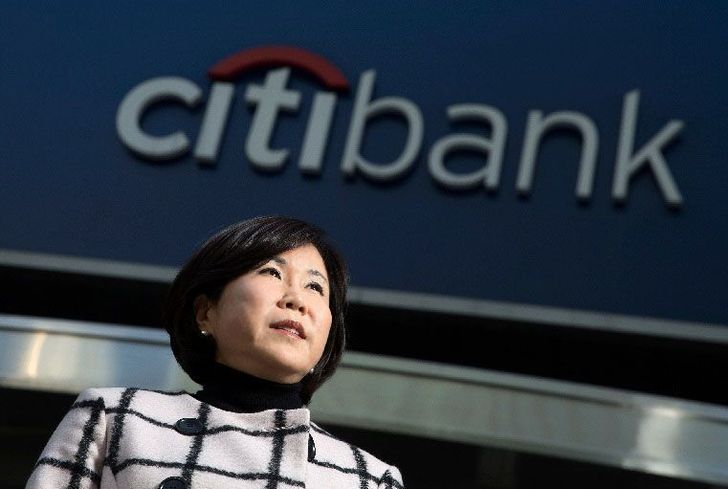
Yoo Myung-soon, managing director of Citibank Korea. / Korea Times photo by Choi Won-suk
Corporate banking chief Yoo stresses strength in global network for clients
By Park Hyong-ki, Nam Hyun-woo
The market is filled with unpredictable forces that can either make or break a company.
From the British exit from the European Union to U.S. President Donald Trump’s America-first policy promoting trade protectionism and Korea’s prolonged presidential scandal, the Korean economy faces increasing volatility and risk.
Companies here cannot rest easy, but need to prepare for any hidden possibilities that can hit and disrupt their operations, even though such preparation may not go as planned. For both companies and individuals, they need to manage their finances with prudence in the face of growing uncertainty.
It will be challenging, risky and daunting as the economy further slows down, even for a commercial banker like Yoo Myung-soon, managing director of Citibank Korea.
“Companies are both concerned and expectant amid uncertainties. There are various ways to finance their operations. My job is to help provide the best possible financial solutions that meet their circumstances,” Yoo said in an interview with The Korea Times.
As the head of Citibank Korea’s corporate banking, Yoo meets with corporate treasurers and chief financial officers, and exchanges ideas on ways to finance investment, working capital, accounts receivable and inventories.
Also, Citibank Korea’s bankers partner with product specialists within the bank to provide a full array of corporate banking solutions, ranging from cash management, foreign exchange, trade financing, loans for custody and clearing, and derivatives.
For instance, she could advise her counterpart in the automobile sector seeking to build and open a plant abroad to take out a long-term loan or finance the factory through export credit agencies such as Korea Trade Insurance Corp.
In terms of loans, the banker can offer to find loans for her client with fixed interest rates amid forecasts of further rate hikes by the U.S. Federal Reserve.
“There are a lot of financing tools, and when using them, it all depends on the situation companies are in. Ultimately, the solutions have to be optimal and cost-efficient for them,” Yoo said.
“These days, providing technology solutions to mitigate cyber security risks is becoming part of the main task in corporate banking as well since companies want to use safe platforms for financial transactions.”
Strength
Yoo said that Citibank Korea will use its strength in having a vast global network to provide such optimal and cost-efficient tools to Korean companies.
She added that the bank is well positioned as it is the only local bank here with a presence in more than 100 countries.
“This enables Citibank Korea to offer access to international markets with a wide range of global products and services. Citi’s client base is the most diversified, serving both multinational and local clients as well as institutional investors with innovative global financial solutions,” she said.
Through its network, Korean companies, for instance, will be able to finance their accounts receivable - or debt documents stating that their customers will pay the money to their suppliers of products and services within a promised timeline - at a Citibank here.
Should a Korean company receive an account receivable via a wire from its customer in London after it purchased products or used services by the former, the Korean company can take the receivable to a local Citibank. The Korean unit of the U.S. banking group can check its customer’s credit and provide accounts receivable financing by taking a certain amount of risk associated with the customer of the Korean company.
The Korean company can also take the receivable to a local Citibank in London for customer credit analysis and financing after its employees seal a sales deal in London.
“If Korean companies make a deal in the U.S., they can finance the receivable there without having to bring it all the way back to Korea. We have a very powerful network in this area,” Yoo said.
With its expertise in understanding the financial needs of its corporate clients, coupled with innovative solutions and products, she added, “Our goal is to become a trusted adviser to our institutional clients operating in Korea and overseas.”
Economic forecast
Citibank expects the Korean economy to grow 2.4 percent this year. China is expected to grow at a slower rate, although the world’s second largest economy will remain Asia’s growth engine.
The global economy is projected to grow 2.7 percent this year on the slight recovery of emerging economies amid stabilizing commodity prices.
But policy changes in the U.S. and China’s slow economy could pose a risk to Korea, given the country’s trade and investment relations with the two countries, Yoo said.
North Korea and its relations with the U.S. and China are another key external factor for Korean companies to consider when conducting business at home and abroad.
“We will need to see how China’s exports gear up against soft global demand, and how it manages rising corporate debt. Moreover, it looks like Europe will face challenges ranging from France’s (presidential) election to the Brexit negotiations,” Yoo said.
Given the harsh economic conditions this year, it would be difficult for Citibank to offer a single best solution as companies prepare for disruptions from geopolitical risks, policy uncertainty under President Donald Trump and financial market volatility.
“Companies cannot rely on one source of financing from banks. They will need to diversify by raising funds via various methods and institutions such as share issuances and loans, depending on their situation, as banks’ risk appetite can change when there is an economic contraction and when a new regulation is introduced,” she said.
Leadership
Yoo is one of the very few female workers who broke the glass ceiling in Korea’s financial industry.
After starting her career as a credit risk analyst at the bank in 1987, it took eight years for her to advance to the head of corporate risk analysis unit at the bank’s Seoul branch.
Since then, she had been appointed to several key sales and marketing posts at the bank. She was the head of sales for the bank’s multinational corporate clients and their global subsidiaries, and led a treasury and trade solutions unit.
In April 2014, she moved to JP Morgan Chase Bank Seoul and was appointed as a co-branch manager. This was the first time that the investment bank named a female branch chief in Korea.
She returned to Citibank in April last year as the head of corporate banking. Citibank said then it put a high premium on her vast experience in corporate financing and expertise in risk management.
“As I look back on my career and the leadership positions I have had, I would offer junior bankers this advice - make a choice, make a difference and make your own success,” she said.
“As we go through our careers, we make small and big choices. Make sure you reach out for advice and information. Once you make the choice, be responsible for the choice you made and own it.”
She said having ownership and showing commitment with accountability, integrity and responsibility can make a big difference in a person’s life and career.
“Naturally, this makes you go the extra mile, enabling you to exceed your clients’ expectations and earn their trust, while gaining new opportunities. This will surely lead you and the organization to success,” Yoo said.