Forum promotes Korea-ASEAN infrastructure investments
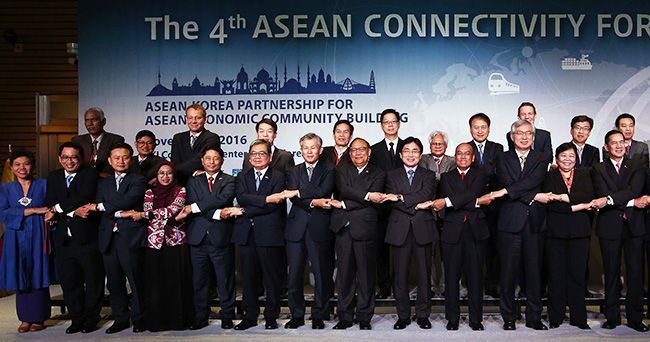
Participants at the 4th ASEAN Connectivity Forum hold hands during an event at the Federation of Korean Industries building on Yeouido, Seoul, Tuesday. Eighth from left is Minister for Transport and Communications of Myanmar U Thant Sin Maung; and to his left are ASEAN-Korea Centre Secretary General Kim Young-sun and ASEAN Connectivity Coordinating Committee Chairman Latsamy Keomany. / Courtesy of ASEAN-Korea Centre
By Nam Hyun-woo
A forum promoting infrastructure investments between Korea and ASEAN countries took place, Tuesday, seeking to assist domestic companies find business opportunities in Southeast Asia.
At the 4th ASEAN Connectivity Forum, jointly hosted by the ASEAN-Korea Centre and the Federation of Korean Industries, infrastructure projects in nine ASEAN countries were introduced alongside explanations about how companies can finance and participate in the projects.
“The forum focused on the Master Plan on ASEAN Connectivity (MPAC) 2025, as well as providing up-to-date information on ASEAN countries’ infrastructure projects,” said ASEAN-Korea Centre Secretary General Kim Young-sun. “The center will support ASEAN countries in having better physical connectivity with each other and help Korean companies find more opportunities in ASEAN infrastructure projects.”
During the ASEAN Summit in Vientiane, Laos, in September, leaders of ASEAN member countries adopted MPAC 2025. This plan is aimed at enhancing the region’s physical, institutional and people-to-people connectivity to cope with looming changes in the region and narrow the gap between each member.
According to AlphaBeta Director Fraser Thompson, who participated in the designing of MPAC 2025, the plan was adopted amid trends or changes that will be critical to ASEAN.
He said the consumer class in ASEAN is forecast to double to 163 million households by 2030 and an additional 90 million people are anticipated to move to cities in ASEAN by then.
In seeking connectivity, massive infrastructure development is expected to be necessary. Up to 2030, up to $3.3 trillion in investment will be required in transport, water, power and telecommunications in the ASEAN region.
He also noted that there are new funding vehicles emerging that could support infrastructure development, such as the Asian Infrastructure Investment Bank, or Partnership for Quality Infrastructure.
During the forum, officials from Asia Development Bank, the Export-Import Bank of Korea and the Multilateral Investment Guarantee Agency provided details and model cases on joining the projects.
“The MPAC 2025 gives a holistic perspective on where the region is going in its efforts to link together infrastructure, both hard and soft, strengthen institutional arrangements and create stronger bonds among ASEAN peoples,” said ASEAN Connectivity Coordinating Committee Chair Latsamy Keomany. “We need to identify and develop specific initiatives and projects, and involve our partners, including Korea and other stakeholders.”
The forum was also attended by Minister for Transport and Communications of Myanmar U Thant Sin Maung and some 200 businessmen from Korean companies.