Exports outlook remains dim despite rebound
By Yoon Ja-young
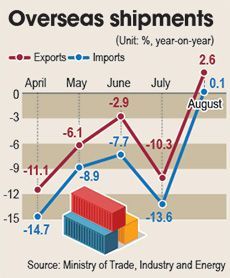
The country’s exports increased 2.6 percent in August from a year earlier, the first turnaround in 20 months.
Analysts, however, remain doubtful about the sustainability of overseas shipments.
According to the Ministry of Trade, Industry and Energy, exports were valued at $40.1 billion in August. Exports had been marking year-on-year decreases for 19 months since December 2014.
The ministry said increasing shipments of semiconductors and other major items led the rebound. Semiconductor exports hit $5.6 billion in August following the introduction of new smartphones. Flat-panel displays and petrochemical products were also among the biggest exports.
The government said exports would have picked up even more if there was no automobile industry strike.
“The strike by automobile workers damaged exports by around $920 million in August,” said Cheong Seung-il, deputy minister for trade and investment. “If there had been no strike, automobile exports would have increased by around 5 percent.”
Imports edged up 0.1 percent to $34.8 billion, the first rebound since September 2014. The trade account posted a $5.3 billion surplus in August. It has been in surplus for 55 consecutive months since February 2012.
However, analysts are cautious about whether exports will continue to pick up.
While exports increased compared with August last year — when they plunged 15.2 percent — they were $900 million less than July. The recovery was also partly due to this August having two more working days than last year.
Negative factors affecting exports, such as a contraction of global trade, low oil prices and a slowdown in the Chinese economy, are continuing.
“Exports marked growth thanks to rising prices, but we must note that the quantity of exports has decreased,” said Ju Won, an economist at Hyundai Research Institute. “It means exports haven’t started a genuine recovery yet.”
He said the decrease in the quantity of exports reflects the fact that the global economy is not yet recovering.
“The crucial point is when demand will start picking up in China,” he said.
Hanjin Shipping’s filing for court receivership is also adding to the concerns of exporters.
“The troubled Hanjin Shipping is another negative factor for exports in the second half of the year,” said Oh Jung-geun, a professor at Konkuk University. He said container shipping fees have already started rising.
“It means rising export costs,” he said. “Korean exporters will lose their competitive edge.”
He said the export rebound was mainly due to a weakening of the won against the yen, which gave Korean exporters a price advantage.
“The won has been strengthening steeply since June,” he said. “It is difficult for the Bank of Korea to further slash the key rate, but Japan is planning one on top of monetary easing. It will lead to a further strengthening of the won against the yen.”
The trade ministry is also cautious about export figures for the coming months.
“Uncertainties are increasing in the financial market due to a possible key rate hike in the United States, and there is also the possibility of the automobile industry continuing to experience strikes,” Cheong said. “The downward risks make it difficult to expect a continued growth of exports.
“On top of expanding support such as trade financing, we will examine the effects of Hanjin Shipping on logistics and cope with it preemptively.”