IMF recommends fiscal, monetary stimulus
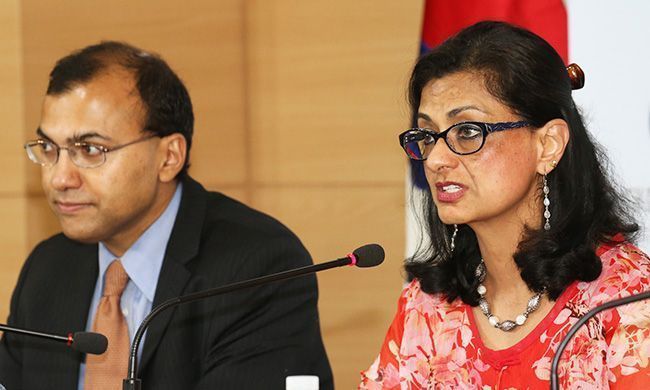
Kalpana Kochhar, a deputy director at the International Monetary Fund (IMF), speaks during a press conference at the Government Complex in downtown Seoul, Wednesday. She said that the government should implement additional fiscal stimulus and the Bank of Korea should adopt monetary easing policies to boost the sluggish economy. / Yonhap
By Kim Jae-won
The Korean government should implement additional fiscal stimulus and the central bank should adopt monetary easing policies to fight low growth and weak external conditions, the International Monetary Fund (IMF) said Wednesday.
Kalpana Kochhar, a deputy director at the IMF who led a seven-member delegation to Korea, said that the country has room to execute a more active stimulus package which may boost the sluggish economy hit by poor exports and low consumption.
“Against this background, macroeconomic policies should be supportive. Speedy implementation of additional fiscal stimulus should be a priority and should be complemented by monetary easing,” said Kochhar in a press briefing in Seoul, wrapping up a two-week visit to the country.
“Given Korea’s low public debt, there is space to use fiscal policy in a complementary fashion, both to cushion the impact of structural reforms and to incentivize such reforms.”
Her remarks came amid expectations that Asia’s fourth-largest economy may expand by less than 3 percent this year, as the external environment is weak and uncertain. The nation’s exports, which have led the economy for the last few decades, have dropped sharply for the last year as global demand is lowering amid an economic downturn.
The IMF executive warned of a premature withdrawal of fiscal support, saying it could undermine the expected rebound in private consumption and keep inflation subdued.
She also mentioned the government’s efforts to recapitalize policy banks leading corporate restructuring, saying fiscal policy should play the lead role in the process while any involvement of the Bank of Korea should be consistent with its mandate.
The government announced earlier in the day that it will inject 1 trillion won into the Export-Import Bank of Korea (Eximbank) which is seeing its capital ratio dropping sharply due to its bad loans extended to troubled shipbuilders and shippers.
The authorities will also create an 11 trillion won fund to support recapitalization of Eximbank and the Korea Development Bank which are facing financial crises due to corporate restructuring.
The IMF said that Korea is facing major structural headwinds, including rapid population aging, heavy reliance on exports and corporate vulnerabilities among others. It also mentioned that the country needs to boost productivity in the services sector, and at small- and medium-sized enterprises.
In terms of labor reform, the Washington, D.C.-based organization said that strong efforts are needed to remove barriers between worker categories and to boost labor force participation.