BOK calls household debt 'manageable'
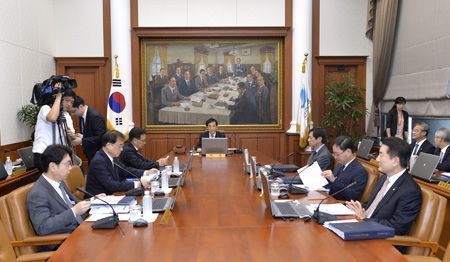
Bank of Korea Governor Lee Ju-yeol, center, presides over a monetary policy meeting at the central bank headquarters in downtown Seoul, Friday. The monetary policy committee decided to hold the base rate unchanged at 1.75 percent. / Korea Times photo by Shim Hyun-chul
By Choi Kyong-ae
Bank of Korea Governor Lee Ju-yeol says snowballing household debt is “manageable.”
He made the remarks after the bank’s rate-setting committee held its key policy rate unchanged at a record low 1.75 percent on Friday.
“When we make a rate decision, household debt is one of the key factors to be considered,” Lee said at a press conference after the decision. “It has shown a sharp increase recently but we see the current level of household debt as manageable.”
To avoid any financial crisis resulting from household debt, Lee said the BOK would consult the finance ministry and the financial regulator to prevent debts from going out of control.
Analysts have said that growing household debt could turn into non-performing loans that would threaten the financial health of banks if interest rates rebounded following rate hikes in the U.S. that are expected later this year.
Household loans jumped 8.5 trillion won in April compared with a 4.6 trillion won increase the previous month.
Home loans rose 1.4 trillion won in January and continued to climb through last month, according to BOK data.
On top of already high levels of household debt, the BOK chief saw more reasons for the rate freeze, such as “gradually recovering consumer demand and increasing stock trades and other financial transactions,” helped by the government’s stimulus packages announced in August last year to boost the nearly moribund real estate market.
The government’s fiscal and monetary policies have helped buoy the construction and home transaction markets but have yet to stimulate consumer spending. “A positive sign is consumer sentiment is perking up these days,” Lee said. “It takes time for rate cuts to have an impact on every corner of the economy.”
He expected consumer prices to remain low due to low oil prices and the won to stay weak against the yen, hurting Korean exporters’ price competitiveness in global markets.
“The won has continued to rise in the past two and half years against the yen,” Lee said. “Carmakers, steelmakers and machinery companies which compete with their Japanese rivals have been hit by a weaker yen. In particular, automakers are struggling with declines in their global market shares,” as a weak yen allowed Japanese rivals to have more room in price cuts and promotions.
Asked if the BOK might cut rates further, he said the bank would make a decision based on economic indicators and risk factors it collects from all sides.
Lee voiced concern over sluggish exports. Korea's exports sank 8.1 percent in April from a year earlier, compared with a 4.3 percent drop in March.
He said that more efforts to overcome structural issues, such as local exporters' weakening competitiveness were important.
Some analysts believe the bank will cut its key rate further.
Meritz Securities analyst Kim Joong-won said, “Other central banks are cutting rates. Most recently, China, Australia and Thailand cut their base rates in May. Korea will likely cut rates in the second half following the trend.”
This week, the International Monetary Fund expected Korea’s economy to grow 3.1 percent in 2015, down from its April forecast of 3.3 percent, due mainly to weaker exports.
The BOK last month cut its growth outlook for this year to 3.1 percent from 3.4 percent. Korea’s economy grew 3.3 percent last year.