Won-yuan trading market opens
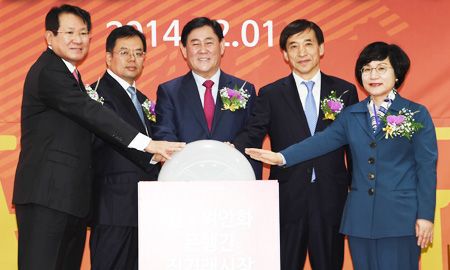
Finance Minister Choi Kyung-hwan, center, with Bank of Korea Governor Lee Ju-yeol, second from right, and Industrial Bank of Korea CEO Kwon Seon-joo, right, at an opening ceremony of the won-yuan direct transaction market at Korea Exchange Bank headquarters in downtown Seoul, Monday. / Courtesy of the Ministry of Strategy and Finance
Exchange costs expected to drop; trade to get boost
By Chung Ah-young
The won-yen direct trading market opened Monday, which is expected to help reduce exchange costs and expand trade between the two countries.
The launch of the currency market follows an agreement between President Park Geun-hye and her Chinese counterpart Xi Jinping during a summit in July.
The Ministry of Strategy and Finance and the Bank of Korea (BOK) announced the market will be open from 9 a.m. to 3 p.m. every business day, at the headquarters of Korea Exchange Bank in central Seoul.
The yuan started trading at 180.3 won. The market enables individuals and corporations to directly exchange Korean won for Chinese yuan.
Previously, the Korean currency could be converted into the Chinese one in banks but banks had to exchange won for U.S. dollars and then convert them into yuan in Hong Kong.
“The won-yuan direct market is like a new venture corporation with huge potential. We will nurture it as a hidden champion with international competitiveness,” Finance Minister Choi Kyung-hwan, said in the opening ceremony.
“The government will support its successful operation through market makers and efforts to build an electronic trading system equivalent to the won-dollar market,” he said.
Choi added that as the country is now equipped with the won-yuan transaction infrastructure, he hopes Korea will join the world’s top three yuan hubs along with Hong Kong and Singapore.
“The free trade agreement with China and the yuan trading market will become engines to to help the nation’s economy grow,” he said.
BOK Governor Lee Ju-yeol emphasized that if necessary, he will arrange a currency swap with China. “If an imbalance between supply and demand occurs, we will make efforts to solve this and will consider a currency swap with China, if necessary,” he said.
The Industrial Bank of Korea, Korea Development Bank, Shinhan Bank, Citi Bank Korea, Korea Exchange Bank, Woori Bank and Standard Chartered (SC) Bank Korea; and the local branches of five foreign banks ― the Bank of Communications, Deutsche Bank, Industrial and Commercial Bank of China, JP Morgan Chase and Hong Kong and Shanghai Banking Corporation (HSBC) ― have been selected as market makers.
They will offer prices and provide liquidity to the won-yuan direct trading market to boost inter-bank transactions between the Korean and Chinese currencies.
China and Korea signed a deal in July to launch a clearing service and open the won-yuan trading market.
Transactions in yuan are rapidly growing on the global trade market, from 2 trillion yuan in 2012 to 3 trillion yuan last year.