Kim Rahn is the managing editor of The Korea Times. Since joining the company in 2003, she has covered various beats including the presidential office, Seoul city government, the Bank of Korea and the tourism industry. In 2014, she won the Society of Publishers in Asia (SOPA) award for her coverage of the ordeals of migrant women in Korea.
Saudi Arabia invites Korean construction companies
By Kim Rahn
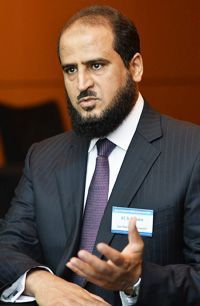
Abdulrahman Bin Mohammed Al-Ibrahim, governor of the Saline Water Conversion Corp., talks about collaboration between the corporation and Korean companies. / Korea Times photo by Shim Hyun-chul
By Kim Rahn
Desalination agencies in Saudi Arabia recognize Korean companies’ production ability highly, and there will be much more chances for Korean firms to join projects, said Abdulrahman Bin Mohammed Al-Ibrahim, governor of the Saline Water Conversion Corp. (SWCC).
Al-Ibrahim visited Korea to participate in the Korea Eximbank MENA Conference. Established in 1974 to solve the country’s chronic water shortage, SWCC is a state-run company operating 30 desalination plants, which make up 21 percent of the world’s total capacity to make seawater potable.
“Korean companies have high-quality production, which is something that my country is extremely eager to have, because such production has sustainability that means longer period of operation and less risk of defects,” he said in an interview with The Korea Times at the Conrad Seoul, Wednesday.
He said Korean companies’ first involvement in desalination projects there was in 1982, by Korea Heavy Industries & Construction (KHIC), the predecessor of Doosan Heavy Industries & Construction.
The 48-year-old governor said KHIC then had no experience in desalination but the SWCC gave it the opportunity to be able to build more experience, and Doosan grew to be recognized in the worldwide desalination industry.
“In 2005, we gave them another opportunity to go for membrane desalination. They didn’t have much experience in the technology but they were able to understand how they should do it and able to build it efficiently,” he said, adding he expects more involvement from Korean companies now.
Al-Ibrahim said Saudi Arabia produced 300 cubic meters of fresh water per day through desalination 50 years ago, but now produces 3.3 million cubic meters and expects the number to double within five years, adding the chance for Korean firms to join is increasing.
He said the country’s water management plan is undergoing a paradigm shift toward a country-wide network.
“Previously we have one project dedicated for one city. But there was no common network within Saudi Arabia. We are now shifting to a more integrated network in the kingdom,” he said.
Another plan is to connect the management system of three water sources _ desalination, aquifers and dams _ so the water can be used together for various purposes. “So the network is an investment by itself, a huge investment for more ability and more water security. This is a huge plan to go for.”
For the greater success of Korean companies in the Middle East, he advised them to show more commitment.
“Previously, Korean companies used to do ‘hit-and-runs,’ meaning they come for a specific project, they want to finish the project, and they go back immediately. This may not give us more comfortable future collaborations. So more physical presence in Saudi Arabia, and maybe more joint ventures with local partners, is needed,” he said.