Kim Rahn is the managing editor of The Korea Times. Since joining the company in 2003, she has covered various beats including the presidential office, Seoul city government, the Bank of Korea and the tourism industry. In 2014, she won the Society of Publishers in Asia (SOPA) award for her coverage of the ordeals of migrant women in Korea.
MENA offers Korean firms opportunities
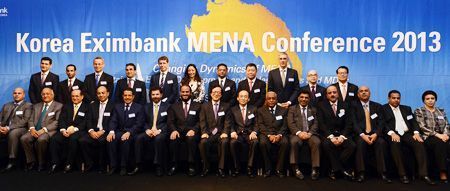
Export-Import Bank of Korea (Korea Eximbank) Chairman Kim Yong-hwan, center in the first row, poses with dignitaries participating in the Korea Eximbank MENA Conference 2013, at the Conrad Seoul Hotel, Wednesday. They include Abdulrahman Bin Mohammed Al-Ibrahim, seventh from left in the same row, governor of the Saline Water Conversion Corp. of Saudi Arabia; and Choo Kyung-ho, ninth from left, vice minister of strategy and finance. / Korea Times photo by Shim Hyun-chul
By Kim Rahn
North Africa, Middle East emerge as ‘blue ocean’ for domestic companies
By Kim Rahn
The Middle East and North Africa (MENA) have been the biggest market for Korean developers operating overseas, and this trend is likely to continue in the foreseeable future.
However, the demand of the region’s industry is rapidly changing, not least the recent interest in renewable energy that has brought fierce competition for orders amid funding challenges.
Participants of the Korea Eximbank MENA Conference 2013 brainstormed how to respond to these challenges. The discussions centered on three main themes: Energy Policy Trends and Outlook of the MENA; The Role of Export Credit Agencies (ECAs) and Multilateral Development Banks (MDBs) in the MENA Project Finance Market; and Emerging Markets in the MENA.
It was widely agreed among participants that the region still presents great opportunities.
Seeking diverse energy sources
There is a high demand for infrastructure and energy projects often costing billions of dollars in the MENA, fuelled by the rapid growth rate there.
However, unlike in the past, demand for fossil fuels is rapidly giving way to renewable energy in response to growing global environmental consciousness and concerns over depleting reserves.
Richard Parris, a partner at the Clifford Chance law firm, addressing the first session said governments in the MENA are steadily embracing renewable energy. He introduced each of the MENA nations’ energy policies and current efforts to diversify their energy sources.
Dayae Oudghiri, head of strategic steering at the Moroccan Agency for Solar Energy, explained the rationale of Morocco’s solar plan, talking about the value of solar resources.
Demands for new funding
The second session focused on funding resources. While the size of construction projects and the amount of required funds is growing, Europe-based commercial banks, which were traditional funding sources, are tightening their purse strings, especially given that Europe’s financial woes have yet to be resolved.
Consequently, loans have to be procured from alternative sources, such as project bonds or investment funds, ECAs and MDBs.
The first presenter of this session was Abdel-Rahman Eltayeb Ali Taha, CEO of Islamic Corporation for the Insurance of Investment & Export Credit, which is part of the Islamic Development Bank Group. He introduced the group’s project financing activities and its investment guidelines.
Korea Eximbank’s plant finance department director Lee Tae-hyung said the role of ECAs and MDBs is increasingly important. Speaking of the bank’s activities to help Korean firms in the MENA region, Lee provided information on its extensive support programs and diversified global networks.
New market of North Africa
The last session focused on North African countries, as Korean companies have mainly executed projects in Gulf Cooperation Council (GCC) member countries previously.
However, competition has become fierce and the Middle East market has become saturated, hence the need to explore North Africa for new opportunities has grown. This session’s presenters shared their expertise and understanding of the region.
John Inglis, a partner at the Shearman & Sterling law firm, presented case studies from Morocco, Egypt and Algeria, such as the countries’ social circumstances, energy development schemes, economic policies, administrative issues, and political and security risks.
Mazen Alsad, director of Standard Chartered Bank’s project & export finance for MENA, said North Africa would have to double its power-generating capacity in the next decade in order to meet its population growth and social development. He presented the energy development status of these countries as well as the current roles of ECAs and MDBs there.