After work endeavor for career
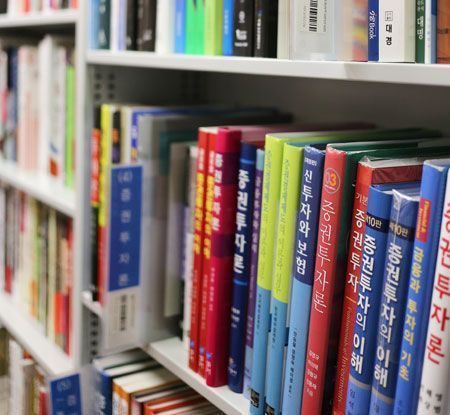
Books about investment are arranged in the finance and accounting publications section at Kyobo Book Center in Gwanghwamun, central Seoul. / Korea Times photo by Yoon Sung-won
Acquiring professional licenses in finance become popular
By Yoon Sung-won
Securities, accounting and other financial fields are said to be some of the most highly-paid and thus favored occupations among jobseekers in Korea. But due to a drop in the number of such jobs amid the prolonged economic slump, it has become harder for jobseekers to enter the lucrative sector.
Additionally, many who work in financial industries have to seek additional capabilities to survive the ever-changing global financial environment. Some who realized such a need were quick to react by obtaining globally-recognized certificates.
Kim Eun-ja, a veteran financial planner at the Shinhan Private Banking Center, is one of those and has acquired licenses including Certified Financial Planner (CFP) while working in the banking industry.
Kim said one of the biggest benefits of acquiring licenses was that she could handle the work she wanted to do. “I’ve dreamed of working in the PB (private banking) sector since I first entered the industry,” Kim said. “So I decided to study for licenses that can prove my knowledge in the PB sector.”
Students attend an information session for nighttime courses at the Academy of International Finance andAccounting (AIFA), a private institute for financial licenses, in southern Seoul. / Courtesy of AIFA
The planner said a structural change in the financial industry was another reason for acquiring professional licenses.
“In the past, each financial institution had clearly separated fields of work — savings, insurance, stocks, etc. But these divisions have collapsed in recent years, requiring employees to devote more time to self-improvement.”
“Though it was not easy to spare time to study after work, I found it worthwhile for I could provide better service to my clients with the knowledge I honed through in-depth study,” Kim added.
Individual office workers, like Kim, are not the only ones working hard to acquire licenses. Companies, to boost competiveness, are supporting their workers by funding them to buy teaching materials and pay for tuition.
“We encourage employees to get licenses and provide the necessary cost for them,” said Dong Jong-hwa, a public relations manager at Samsung Securities. “The company offers full expenses for employees who challenge high-grade licenses like CFP to help them improve themselves for better customer service.”
Besides CFP, those who work in the finance and securities sector prefer Chartered Financial Analyst (CFA) and American Institute of Certified Public Accountant (AICPA) courses, but the preference changes by industry segments.
“To elaborate, employees in accounting, planning, analyzing, and M&A businesses choose AICPA, because they need to learn how to comprehend complicated financial statements,” said Hwang Sun-woo, a representative of the Academy of International Finance and Accounting (AIFA). The academy is one of the leading educational institutions for financial licenses in Korea.
“On the other hand, fund managers, stock brokers, currency traders, and finance engineers pick CFA courses. It’s because their work is mostly about seeking profits based on a profound understanding of various financial instruments,” Hwang said.
CFAs are specialists in securities investment, certified through the test administered by the Institute of Chartered Financial Analysts in the United States.
As it is one of the most prestigious financial licenses in the U.S., applicants are first required to have a bachelor’s degree from a four-year-course college or work experience for more than four years. After they meet those requirements, applicants must pass three stages of tests in succession.
Though not all global certificates are officially accepted under the current Korean law system, they are still widely recognized and respected in employment and promotion evaluations at many private and public companies in Korea. Thanks to such benefits, local academies that offer courses for global licenses are crowded with tireless office workers who study after work.
“Some 800 students are currently attending our AICPA courses. About 75 to 85 percent of the total students are office workers who have to spend their weekdays at work. The number of these office worker-students has increased to over 70 percent in the last few years,” Hwang said. “In the past, the proportion was about 60 percent at most.”
AICPA originally referred to a U.S. accountants’ organization established in 1887. In Korea, however, the abbreviation is commonly used to refer to a certified public accountant chartered by the U.S. organization. A CFA works in the business consulting sector and advises on international standards including U.S. accounting systems and International Financial Reporting Standards (IFRS).
To acquire an AICPA license, applicants are required to attend several hours of lectures in business management or accounting studies. Once the prerequisites are met, applicants must pass four different test subjects including financial accounting & reporting, auditing & attestation, regulation, and business environment & concepts within 18 months. The test is held at about 300 sites in the U.S.
“For the AICPA certificate, 12 to 18 months of study is needed on average, provided one studies three hours a day after work. And more than three years is required for a CFA license since its test procedure runs for three years,” the AIFA representative explained.
The academy offers both weekday and weekend classes for the same subject to give choices for students who work on weekdays. Some weekday classes start at 7:30 p.m., giving students the opportunity to utilize their after-work time.
An online review service is provided as well. Students can revisit what they learned in class by watching video clips online. The service is also available on mobile devices, including smartphones and tablet computers.