Kim Rahn is the managing editor of The Korea Times. Since joining the company in 2003, she has covered various beats including the presidential office, Seoul city government, the Bank of Korea and the tourism industry. In 2014, she won the Society of Publishers in Asia (SOPA) award for her coverage of the ordeals of migrant women in Korea.
Hana to expand customer base
CEO Kim plans to focus on mobile banking, SME lending
By Kim Rahn
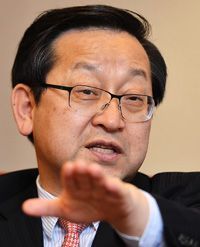
Hana Bank CEO Kim Jong-jun speaks during an interview at his office in downtown Seoul, Wednesday. / Korea Times photo by Shim Hyun-chul
By Kim Rahn
Launched in 1991, Hana is a relatively young bank but it has become well established here, leading the financial market in sectors such as private banking.
However, the short history is sometimes a weak point because the bank has fewer customers than its competitors, consequently preventing it from capitalizing on economy of scale.
So Hana Bank CEO Kim Jong-jun plans to double efforts to expand the customer base this year.
“We have a relatively large number of VIP clients but a small number of ordinary customers. We have solid term deposit base but are weaker in terms of demand deposits. Now we need to increase the size of the latter,” Kim said.
Demand deposits and other low-cost funding enable banks to earn stable profits. Such efforts have been gaining results. As of December 2012, the average monthly balance of such deposits was 13.6 trillion won, up 8.4 percent from 12.5 trillion won a year before.
But Kim’s strategy is not focused on stealing customers from other banks. “We are trying to activate dormant customers, persuading them to actively use Hana accounts and not to transfer to other banks.”
Regarding this year’s business strategy, Kim said that he will put top priority on maintaining a balance between risk management and growth, expecting that economic slump will continue for a while.
“Amid low interest rates and weak growth, the banking industry will face challenges and has to find new growth engines. Rather than enlarging size, we’ll focus on risk management and enhance other internal capabilities,” the 57-year-old said.
Another sector Hana will emphasize is expanding loans to small- and mid-sized enterprise (SME) clients.
The move is in line with President-elect Park Geun-hye’s corporate policy that will focus on SMEs and a “fair” relationship between conglomerates and smaller firms. But Kim said that such support for SMEs is more than just policy matching.
“It means winning future customers. SMEs have both risk and opportunity. If we offer loans to promising companies by applying an appropriate qualification screening standard, we can secure blue-chip corporate customers, and employees working for the firms can also become our customers. Support for SMEs can bring co-development for the companies and the bank,” he said.
The lender will introduce state-supported low-interest loans to SMEs and expand counseling activities at branches in industrial complexes.
Hana will also intensify its mobile services because a growing number of customers are using online and mobile tools for banking. Between 2000 and 2012, the number of customers visiting branches was cut to one-eighth, while that for online and mobile channels increased 10-fold.
“We are leading the sector in terms of technology and ideas but other banks will soon catch up. We’ll have to create various, unique mobile services. It is not only following the current tendency but also preparing for the future,” the CEO said.
Hana has also been engaged in various corporate social responsibility activities, including support for interracial families.
For families with a Vietnamese parent, the bank’s parent company, Hana Financial Group, published fairy tale books and biographies of great men written in both Vietnamese and Korean, so that children can learn the stories and history of both countries and the Vietnamese parent can learn Korean.
The group has also made efforts to solve other problems Korean society faces, including a low birthrate, household burdens for private tutoring, and an aging society.
It has set up daycare centers in Seoul and Gyeonggi Province together with several companies to help working mothers, while establishing Hana Care Center, a nursing home for the elderly. It also founded Hana Academy Seoul, a high school dedicated to public education to tackle the problem of excessively priced private tutoring.