Betting on a robotic future
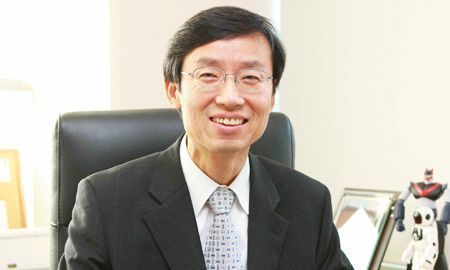
Yujin Robot CEO Shin Kyung-chul talks about potentials and hurdles
By Bahk Eun-ji
Yujin Robot CEO Shin Kyung-chul believes that the cohabitation of people and robots is attainable within a decade.
“In many workplaces, workers will be replaced by robots,” he said. “I strongly believe that the age when humans and robots coexist is just around the corner. By 2020, every home will have a robot. Ten years after that, every individual will have one.”
Shin joins the robotic world
Two decades ago, Shin joined Yujin Robot, which is the country’s foremost manufacturer of industrial, home-service and entertainment robots, as well as automation systems.
As a boy, Shin dreamed of becoming a scientist like Albert Einstein. Throughout his academic and professional career, Shin’s primary interest has been in robots and machinery. After earning a bachelor’s and master’s degree in mechanical design and production engineering at Seoul National University, he studied at the University of Michigan.
With his credentials, Shin could have joined universities in Korea or in the United States, or entered a research institute affiliated with a conglomerate. Instead, he opted to join a small start-up that nevertheless had huge potential.
Shin joined Yujin Robot as president in 1990. The company was established in March 1988 with only 10 employees. It now has around 117 employees, and its revenue was around 25 billion won in 2011.
Yujin Robot is known as a pioneer of personal-service robots, especially those intended for domestic use.
Products such as iClebo, a cleaning robot, iRobi, an education service robot, and TurtleBot, an open-end robot platform for researchers and inventors, attract end users and researchers both at home and abroad.
The cleaning robots and education-service robots are the most profitable. More than 20 countries purchase them, including Germany, France, the Netherlands, Denmark, Japan, Taiwan, Saudi Arabia, United Arab Emirates and Australia. Yujin exports $5 million worth of products per year.
“The figure $5 million is not a great amount. But, in consideration of the small market size of the personal-service robot, it is significant. On a more positive note, the market is growing fast.”
Invitation to the robotic world of the future
“Are you ready to buy a home robot?”
“In a wired South Korea, robots will feel right at home.”
Under these headlines, journals such as Businessweek and The New York Times described the Seoul-based company as laden with potential.
At less than $25 million in annual turnover, and with less than 120 on their payroll, the scale of the company is small compared to other global corporations.
However, many people related to the industry from around the world visit the small firm, and foreign media as well as overseas buyers show a special interest in the company. Yujin Robot lives up to the expectations: it has made its presence felt across the world.
“I have to admit that Germany and Japan are slightly more advanced when it comes to industrial robots used in factory automation. But we have far better skills and technology in personal-service robots,” the president said.
Shin predicts the personal-service robot will, in the future, be as ubiquitous as the smartphone is today.
“Nobody expected every person to have their own smartphone, but it has now become a must-have item, at least for Koreans. In the future, I expect people will need their own robot just like they need a smartphone,” the president said.
Along the same line, Shin has developed an elderly care service robot. It is still at the experimental stage, but experts anticipate substantial demand as many countries, including Korea, are rapidly becoming an aging society.
Shin imagines a day with an elderly service robot. The robot wakes senior couples with beautiful music. After they have eaten breakfast, it hands out the pills that they have to take daily. It then explains what the couple has to do that day. If there is a medical problem or if they feel anything strange, the robot immediately makes a call to their doctor.
“I believe we will be able to unveil the elderly service robot within five years,” Shin said.
Major hurdles
As the pioneer in the robot industry, Yujin Robot has gone through many hardships and still has many major hurdles to surmount.
Recently, conglomerates have joined the competition with robots similar to Yujin’s most profitable product, iClebo.
“Large companies usually have a more advanced marketing strategy, and sometimes they have their own distribution channel,” said Shin. “Moreover, unlike small companies, conglomerates have the ability to offer good after-sales service.” However, he remains optimistic. “Quality and performance of products are the winning factors in this competition for us,” he said. “We hope consumers will purchase our products because of their excellent quality.”
He also noted that he has invested heavily in R&D, so that Yujin will be able to maintain a strong share of the future market.
“The hardest part is that R&D for robots costs a lot, but the market is still growing,” he said.
As the technical standards for robots have not been officially established, many countries are trying to take the leadership. This, Shin says, is the most critical issue facing the robot industry.
The president pointed out that they provide their products and systems as a platform for inventors and researchers, with the aim of seizing the initiative in the industry. The president expects the new government led by President-elect Park Geun-hye to lead the initiative to foster the robot market in Korea.