Gaming industry faces diverse challenges
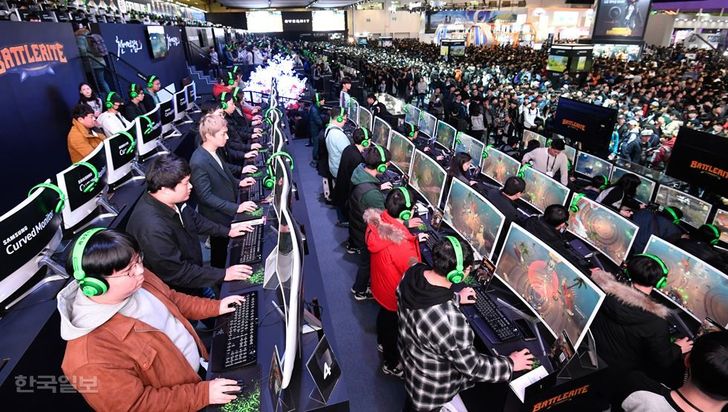
Visitors play games at G-Star 2017 in Busan, Nov. 16, 2017. / Korea Times photo by Jeon Hye-won
By Kang Seung-woo
The promising Korean gaming industry is facing a range of challenges ahead although the government regards it as the nation’s new growth engine.
With China’s ban on Korean games’ release there lingering, local companies are also facing rising domestic issues, which may put a damper on the industry.
Last year, the gaming sector ushered in a new era of local players chalking up annual individual revenue of over 2 trillion won ($1.84 billion) as Nexon and Netmarble Games reported 2.3 trillion won and 2.42 trillion won, respectively. No. 3 NCSOFT also stood at 1.76 trillion won.
Shutdown law
The biggest issue concerning the industry is whether to abolish the so-called “shutdown law” for online games that prevents those aged under 16 from accessing online games from midnight till 6 a.m. to curb game addiction among adolescents.
The game industry has high hopes for President Moon Jae-in to scrap the law.
During his election campaign, Moon repeatedly pledged to foster the game industry as the nation’s new growth engine, raising expectations that his administration would lift regulations on the industry.
In addition, the game industry has been thrust into the limelight as a high value-added business in the time of the Fourth Industrial Revolution.
According to the Korea Creative Content Agency (KOCCA), the domestic games market was worth 11.6 trillion won last year.
In addition, games gained a large presence in the nation’s content exports.
Games accounted for 56 percent of the overall content exports last year -- $3.77 billion out of 6.74 billion, the KOCCA added.
Given the situation, the game industry is strongly calling for the government to scrap the law, saying games are the technical test bed to help the nation lead the Fourth Industrial Revolution.
“The shutdown law is groundlessly spreading negative perception about games and controlling the youth, not addressing the game addiction problem,” said an official of the game industry.
The shutdown law went into effect in November 2011 enforced by the Ministry of Gender Equality and Family. In addition, the Ministry of Culture, Sports and Tourism also introduced the “selective shutdown system” in July 2012.
However, the rule does not affect mobile and console games.
Since its initiation six years ago, it has been at the center of a storm as the game industry and avid gamers alleged the government’s excessive interference was violating basic constitutional rights including young people’s right to pursue happiness and their parents’ right to decide upon their children’s education.
The issue went dark after the Constitutional Court ruled the law was constitutional in 2014.
Amid a growing outcry over the law, some lawmakers have stepped up efforts to abolish it.
“It is time to review the law as the government is focused on fostering the game industry and the regulation is facing various unwanted effects,” said Rep. Shin Yong-hyeon of the minor opposition Bareun Mirae Party.
“The current law is the absolute good, but the issue has yet to be put on the table for discussions, which is strange.”
Rep. Kim Byung-kwan of the ruling Democratic Party of Korea laid into the government’s unyielding attitude toward the issue.
“There have been a number of discussions within the National Assembly, relevant organizations and academic circles, but the family ministry has skipped them despite repeated invitations,” Kim said on his social network service account of late.
Gender Equality and Family Minister Chung Hyun-back made it clear during her confirmation hearing last July that she opposed an abolition of the shutdown law, rebuffing the allegation that the regulation had depressed the game industry.
Since the hotly debated law was put into practice in 2011, domestic online games’ revenue has decreased from 6.24 trillion won in 2011 to 4.65 trillion won in 2016 according to the KCCA.
On the other hand, mobile games, exempted from the regulation, saw rapid growth during the same span from 268.4 billion won to 4.33 trillion won.
Gaming disorder
The game industry is confronting a bigger challenge from the World Health Organization (WHO) planning to add “gaming disorder” to the list of addiction diagnoses in its International Compendium of Diseases in May.
According to the WHO, gaming disorder is defined as a pattern of gaming behavior characterized by impaired control over gaming, increasing priority given to gaming over other activities to the extent that gaming takes precedence over other interests and daily activities, and continuation or escalation of gaming despite the occurrence of negative consequences.
The game industry is concerned about possible huge fallout from the gaming disorder classification, while forming an alliance with its global counterparts against the WHO proposal.
According to the Korea Association of Game Industry, March 1, it, along with the Brazilian Union of Video and Games and Interactive Entertainment South Africa, joined 22 international trade bodies to urge the WHO to reverse its plan to create the planned classification.
In addition, 36 scientists, researchers and mental health experts are opposing the WHO plan with a new paper titled: “A Weak Scientific Basis for Gaming Disorder: Let us err on the side of caution,” according to Ukie, the U.K.’s games and interactive entertainment industry trade body.
“Much confusion remains -- even among authors supporting the diagnosis -- regarding what, exactly, gaming disorder is,” they said in the paper’s abstract.
“We maintain that the quality of the existing evidence base is low.”
Wi Jong-hyun, the head of the Korea Game Society, said, “The WHO’s proposal to add gaming addiction to its list of diseases could prevent developers from fully using their creativity and shrink the game industry ecosystem.”