LG CNS aims to make Busan Asian hub for data handling
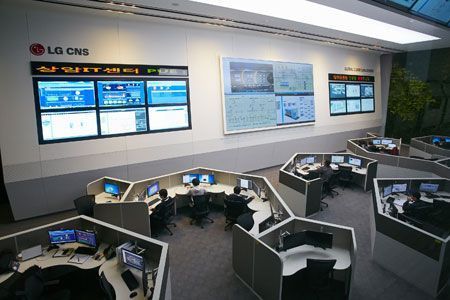
LG CNS employees work at a control room of its global cloud data center in Busan. / Courtesy of LG CNS
By Cho Mu-hyun
BUSAN ― LG CNS, an IT service affiliate of LG Group, aims to make its Busan data center an Asian data hub in order to get the upper hand in a lucrative, rapidly-growing market, according to a ranking executive, Friday.
“We want to use our Busan Global Cloud Data Center as a bridgehead to connect with rising capitals in the Asia Pacific Region,” said Son Joon-bae, vice president of LG CNS’s outsourcing business, at a media briefing held inside the center.
Son said that Singapore and Hong Kong, the financial capitals of the region, are now turning into what he called data capitals, and stressed that LG CNS’s expansion plans will put Korea on a par with them.
Among local rivals, the company boasts one of the longest track records ― 27 years taking care of database management for major local and global clients, both in the public and private sector.
“Korea is a dynamic market, but the geopolitical risk caused by North Korea as well as the language barrier have limited our client base,” he said. “We used the recent Special Olympics and our credit rating to clinch global clients.
“The increased recognition of Korea’s prowess and penetration in IT is helping us secure more global clients, and we are in talks with customers from the United States and Japan.”
According to Gartner last year, Asia saw the biggest rise in data centers, with China accounting for 27 percent and countries and cities in the Asia Pacific region, such as Singapore, Hong Kong and to a lesser degree, Taiwan, taking up 40 percent.
By CNS’s own estimates, it is ranked third in IT infrastructure and manpower behind companies in the United States and China, and Son expressed his company’s aggressive intention to expand in data centers. “There are customers and demand in this market,” he said.
The Busan Global Cloud Data Center launched last December is as wide as five football fields combined and five-stories high,
Together with the Ministry of Knowledge Economy and the Busan local administration, LG CNS plans to make the vicinity a data center park, much like one planned in Singapore, also funded by its government.
“Busan has a well established infrastructure, making it the best place for a data center hub, and many clients are showing interest because it is convenient for reciprocal data sharing with Japan,” he said.
The IT service provider already has three data centers widely used by multiple local and global clients at Sangam, Gasan and Incheon. Sangam, built in 2007, is the largest and main data center, serving customers from the finance, telecommunications and IT industry. Incheon and Gasan, set up in 1992 and 2009, respectively, have Internet portals as clients. It has three overseas centers, in Amsterdam, New Jersey and Beijing.
“With our planned data park and data centers worldwide, we want to provide clients with a total service,” said Son.
The Busan facility uses the most recently developed technology solutions, allowing it to operate with low power consumption and be as environmentally friendly as possible.
The center has 72,000 servers, 15 percent of which are occupied by clients including Kakao that is collecting and using a massive amount of data via its free mobile messenger. It is a bridgehead for companies like Kakao to eye Japan, said Son. The manager of Kakao Talk use around hundreds of servers at Busan.
The most important thing in maintaining a data center is the cooling system ― something that has become more imperative with the emergence of cloud computing.
The Busan facility has what the company calls built-in outer cooling, a patented cooling system developed by LG CNS that absorbs outside air to cool servers using low power from January to May, and October to December. During the summer, a freezer is simultaneously activated to make sure no humidity or heat impairs operations.
Alternate and direct current are both used for efficient power consumption, which can be switched according to client demands, said LG CNS’s engineer Yang Jae-kown, who designed the center.
The company adopted its self-developed Smart Green Platform (SGP) that allows total control of equipment, facilities, security, energy use and data management at the center. Servers are heavily guarded by infrared sensors and CCTVs. To prevent theft, anybody entering inside the server block has his weight automatically checked.
Out of the 145 pillars supporting the data center underground, 96 have 2 meters thick rubber bearings for to protect from earth quakes. It is also protected from floods.