Samsung, SK hynix on lookout for further developments in US chip export policy
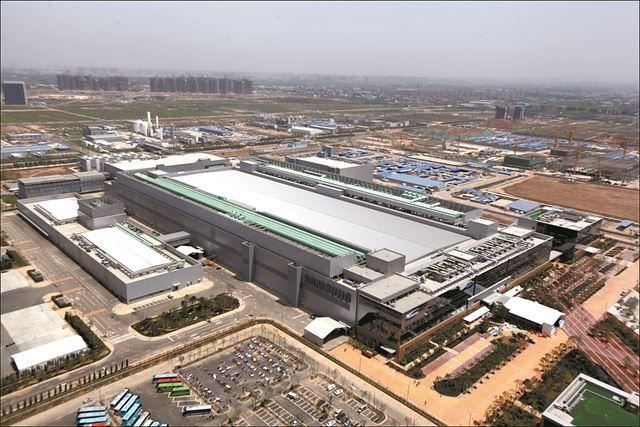
This undated file photo, provided by Samsung Electronics, shows its semiconductor complex in Xian, China. Yonhap
Korea's chip industry is keeping close tabs on the status of exemptions from Washington's export control measures designed to limit China's access to advanced chip technologies following a report that such exemptions could be extended.
The Wall Street Journal reported Monday that Alan Estevez, under secretary of commerce for industry and security, told an industry gathering last week that the United States intended to extend existing exemptions for the foreseeable future.
Last October, Washington temporarily exempted Samsung Electronics and SK hynix, the world's two largest memory chip makers, from its export curbs against China.
At that time, the U.S. Department of Commerce allowed the two Korean chipmakers to engage in the activities necessary to maintain current production of integrated circuits in China for one year without further licensing requirements.
On Tuesday, Samsung and SK hynix declined to comment on the article.
It had been feared the sweeping export curbs would disrupt the operations of Korean chipmakers, as they must undergo a case-by-case review by Washington to get authorization for business transactions in China.
Under the restrictions, companies should receive a license for equipment exports to Chinese firms that make advanced chips, such as DRAM chips that are 18 nanometers or below, NAND flash chips with 128 layers or more and logic chips 14 nm or below.
Samsung, the world's largest memory chip maker, runs a chip manufacturing plant in the Chinese city of Xian, which is responsible for some 40 percent of its global NAND flash production. In Suzhou, the chipmaker runs a semiconductor packaging factory.
SK hynix currently operates multiple plants in China, including one in the eastern city of Wuxi where it manufactures about half of its global DRAM chips.
Aside from the export curbs, Washington has put pressure on global chipmakers to align with it in an ongoing race for chip supremacy through the $53 billion Chips and Science Act, which demands recipients of federal money limit their investment in China. (Yonhap)