Baek Byung-yeul is a journalist at The Korea Times focused on cultural content, including films and cultural events in South Korea. You can contact him at baekby@koreatimes.co.kr to share your insights.
Samsung chief urged to diversify top executives, board members
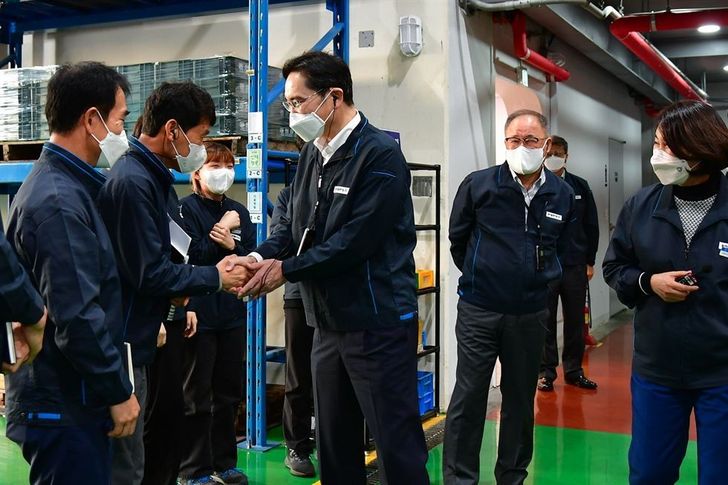
Lee Jae-yong, center, chairman of Samsung Electronics, shakes hands with an employee of Dong-A Plating in Busan, Nov. 8. The plating company was able to establish a smart plant system with help from Samsung. Lee visited the company as part of his efforts to pursue win-win growth with the country's small and medium-sized enterprises. Courtesy of Samsung Electronics
By Baek Byung-yeul
'Seeking acquisitions, growing foundry are keys to further growth'
By Baek Byung-yeul
Lee Jae-yong, who was promoted from vice chairman to chairman of Samsung Electronics, the crown jewel of Samsung Group, on Oct. 27, faces the daunting task of weathering multiple challenges, including a chip market slump, legal risks and finding new growth engines to keep the nation's largest conglomerate competitive.
To this end, industry experts stressed that Lee needs to fill the chipmaker's board with directors capable of fiercely discussing the direction of the industry, while rallying mid-level executives to proactively detect rapidly-changing global trends.
They added that the chairman should focus on diversifying the portfolio of Samsung Electronics, which is still highly dependent on memory chips and overhaul the governance structure of the group, in which each affiliate owns stakes in each other like a spider web, in order to strengthen his governing base.
Samsung's board lacks industry experts
Shin Tong-chan, a partner at one of the nation's major law firms, Yulchon, asked why Samsung Electronics' board members are not made up of industry experts and why almost all of them are Koreans, even though the chipmaker has a global client base.
Shin, who's also an international trade expert, said he noticed that Samsung's board of directors is made up of professors and socially prominent figures, adding that this is the opposite of Taiwan's TSMC, which filled its board with multinational members with a high level of industry knowledge.
“When looking at the webpages of Samsung Electronics and TSMC, I could find out there are big differences between the two in terms of choosing board members. By nationality, 10 out of Samsung's 11 board members are Koreans except for one American, while four of the 10 board members of TSMC are from Western countries,” Shin added.
Also, most of Samsung's board members are professors specialized in law or finance. TSMC, on the other hand, filled its board with incumbent or former industry players who are serving or served as chairmen or CEOs in the IT sector. The Taiwanese company also has one academic figure, but he is the president of the Massachusetts Institute of Technology,” he said.
Shin said Samsung also needs to organize its board members with technological backgrounds like TSMC at a time when the Taiwan-based foundry company overtook Samsung in quarterly sales.
“We don't know which one is better. No one knows if Samsung could produce better results should it change its members with a deep understanding of the chip and IT industries. But I know that TSMC's method is what leading companies in the Silicon Valley have chosen. Rather than appointing socially prominent people as directors, I think it is necessary for Samsung to organize experts from the same industry so that they can fiercely discuss Samsung's strategy and direction,” the attorney said.
Lee Jae-yong, left, chairman of Samsung Electronics, inspects Samsung Biologics' newly-opened fourth plant in Songdo, west of Seoul, Oct. 11. Courtesy of Samsung Electronics
'Don't be siloed, think broadly'
In terms of how to set up the group's mid-level executives, the new chairman was advised not to be “siloed” and try to surround himself with thinkers, according to John Walker, the former chairman of Macquarie Group Korea and now chairman of Eastpoint Partners.
“I think it is now more important than ever for Samsung to hire professional leaders from a diverse background. They are clearly good at the 'hardware' but the 'software' ― high-ranking people who innovate and think about global trends before they become obvious ― is all the more important,” Walker said.
“An understanding that 'convergence' is occurring so that a new green transition business opportunity is with us is so important. This is a convergence of critical minerals mining, logistics, technology and manufacturing followed by development, construction and operations. This means that Samsung should become less 'siloed' and think of ways for its various subsidiaries to have a shared objective,” the chairman said.
“In short, the new chairman should surround himself with thinkers and technical experts, but with less focus on engineers and more focus on managers,” Walker added.
Lee Jae-yong, center, chairman of Samsung Electronics, poses with employees of Samsung Electro-Mechanics during a ceremony commemorating the first shipment of flip-chip ball grid arrays (FCBGA) substrate at Samsung Electro-Mechanics' plant in Busan, Nov. 8. Courtesy of Samsung Electronics
Diversifying portfolio
Samsung Electronics has been mainly focused on semiconductors, mobile devices, home appliances, TVs and displays. The portfolio, which was built under late Chairman Lee Kun-hee, Lee Jae-yong's father, is stable, but industry analysts said the younger Lee needs to discover new growth engines through acquisitions and by continuing to grow and develop its chip foundry business.
In 2012, Samsung Electronics told securities companies that it aimed to achieve annual sales of 400 trillion won ($298.5 billion) by 2020. The year 2012 was the first year that the chip maker reached the 200 trillion won sales mark.
Since then, however, its revenue has been stagnant as the company generated sales of 236.81 trillion won in 2020 and 279.57 trillion won last year.
“In terms of credit challenges, Samsung Electronics is still highly dependent on the memory chip business as its main earnings and cash flow driver. This segment, though, remains a deeply cyclical business and requires substantial capital spending to support technology migration,” Gloria Tsuen, vice president and senior credit officer of Moody's, told The Korea Times.
“The company has been seeking to grow its foundry business. However, it has not been easy and it remains a distant No. 2 to market leader TSMC, which has an independent, pure foundry business model and does not develop its own chipset or compete with its customer,” the vice president said.
“Samsung also has leadership in the plastic, organic light-emitting diode (OLED) display panel market. But competition there is also increasing and, in any case, the segment's operating profit contribution is moderate, at only 15 percent of the semiconductor segment's in 2021,” she added.
To diversify its portfolio, Samsung's executives have said the company has been actively seeking acquisition opportunities for years, but no deal has been made yet. The major acquisition deal it conducted was acquiring U.S.-based connected car and audio system company Harman in 2016 for $8 billion.
Despite the stagnant growth, Kim Dong-won, an analyst at KB Securities, said investors are constantly looking forward to Samsung, saying “Samsung Electronics is expected to have differentiated cost competitiveness and defend its profit better than other chipmakers even though the memory chip business is on a down cycle.”
“Based on 110 trillion won in assets of cash and cash equivalents, Samsung is expected to continue to expand its memory and foundry production capacity and secure new growth engines through acquisitions,” he added.
Considering the fact that the global economy has been facing severe adversities, there are views that it would be better for Lee to stick to what Samsung is good at, instead of trying to do something different.
“With regards to what Lee Jae-yong may do, I am not so sure at the moment. There have been so many different scenarios being thrown around. Perhaps, the safe thing to say is for the status quo to remain intact,” a tech industry analyst in Asia said on condition of anonymity. “It is especially made so difficult since the global economy is in such dire straits.”
How will new chairman increase control of group?
Governance-wise, his weak grip on Samsung Group is another immediate challenge for the new chairman. Lee governs Samsung Group through its web-like holding structure.
Even though Lee only owns 1.63 percent of Samsung Electronics, he possesses around an 18.13 percent stake in Samsung C&T, which owns 19.34 percent of Samsung Life Insurance, which in turn owns 8.51 percent of Samsung Electronics.
Lee controls the group in such an indirect way, but if the so-called “Samsung Life Insurance law,” which is currently pending at the National Assembly, is passed, there is a possibility of his control over the group becoming weaker.
The Samsung Life Insurance bill is aimed at restricting financial companies from investing more than 3 percent of their total assets as a preemptive risk management measure to protect money deposited or invested by customers. If the law is revised, Samsung Life Insurance will be forced to sell its stake in Samsung Electronics.
Experts said various scenarios, such as introducing a holding company system, are considered as a measure to strengthen Lee's grip over the group.
“As the voting rights of those with a special relationship with the largest shareholder of Samsung Electronics are limited to 15 percent, the view that Samsung Group needs to adopt a holding company system is gaining traction,” Choi Nam-gon, a researcher at Yuanta Securities, said.