Baek Byung-yeul is a journalist at The Korea Times focused on cultural content, including films and cultural events in South Korea. You can contact him at baekby@koreatimes.co.kr to share your insights.
Steelmakers changing strategies on carbon neutrality directive
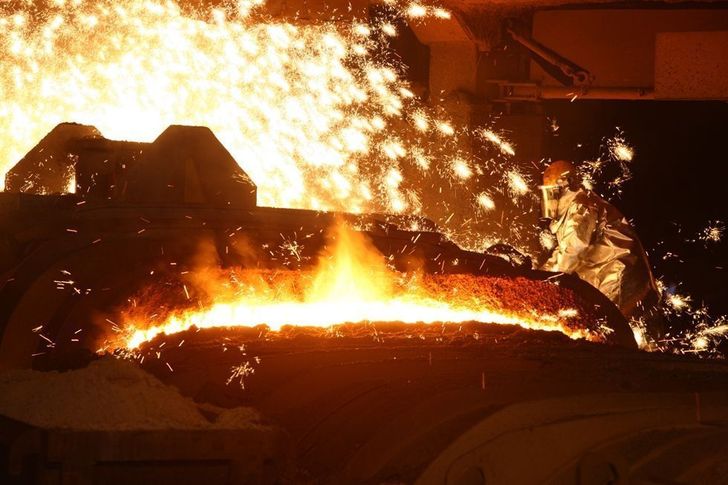
A furnace at POSCO's Pohang plant / Korea Times file
By Baek Byung-yeul
By Baek Byung-yeul
Korean steelmakers such as POSCO, Hyundai Steel and Dongkuk Steel Mill are changing their steel production methods in a desperate move to fall in line with the government's tightened regulations intended to reduce greenhouse gas emissions.
The government has been taking drastic moves to cut carbon emissions. In August, the country became the world's 14th nation to legislate a Carbon Neutrality Act after the National Assembly passed a bill mandating a 35 percent cut in greenhouse gas emissions by 2030, to achieve net-zero emissions by 2050.
Among industries, steel manufacturing is one of the sectors in strong contravention of the government's drive to cut carbon emissions as their processes produce enormous amounts of carbon dioxide from steel furnaces.
In order to meet with the government's goal to achieve net-zero emissions by 2050, steelmakers are focusing on producing low-carbon steel as they are increasingly utilizing mini-mills that have electric arc furnaces to melt recycled scrap steel using electric power.
The mini-mills had been considered an unpopular steel-producing method, due to high electricity cost and low productivity compared with the traditional blast furnace steel mills. However, they are gathering interest because their carbon emissions are only around a quarter compared to blast furnace steel mills.
According to industry insiders, POSCO, the country's largest steel producer, plans to build mini-mills, although it had previously abandoned its mini-mills around 2015 due to their high cost and low productivity. The company is expected to build a mini-mill at its Gwangyang steel mill site by 2025 and add another mini-mill at its Pohang site by 2027.
Using these mini-mills, POSCO expects it will be able to reduce carbon emissions to under 71 million tons a year by 2030. From 2017 to 2019, the company's annual carbon emissions were around 78 million tons on average.
The carbon neutrality drive has also made steelmakers use more scrap steel, which can reduce the process of heating and melting iron ore, an essential raw material for the manufacture of steel.
The tightening regulations for achieving carbon neutrality have raised the value of scrap steel. According to industry data, the price of heavy melting scrap A, regarded as a benchmark indicator for scrap steel, was priced at 572,000 won ($479) a ton in the second week of December. The figure jumped more than 80 percent from the average price of 312,000 won in December 2020.
Due to the increased price, steelmakers are working on securing a stable supply of scrap steel. Dongkuk Steel Mill recently established a steel scrap yard in Japan while Hyundai Steel purchased a large scrapped ship for recycling.