Baek Byung-yeul is a journalist at The Korea Times focused on cultural content, including films and cultural events in South Korea. You can contact him at baekby@koreatimes.co.kr to share your insights.
Local bio firms to invest W6.29 tril. to make Korea global vaccine hub
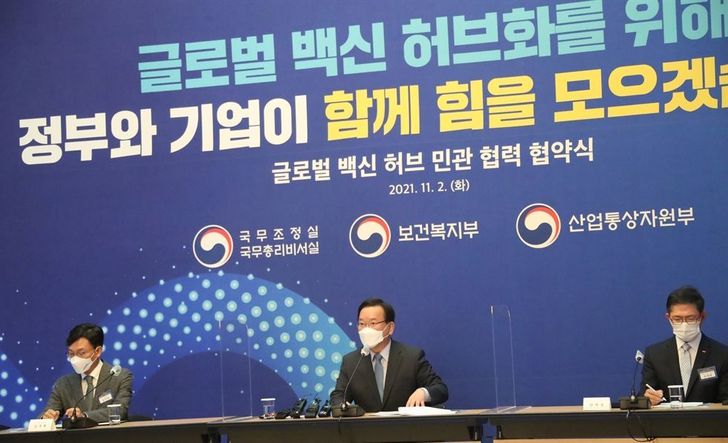
Prime Minister Kim Boo-kyum, center, speaks during the Global Vaccine Hub Preparatory Committee's meeting in Seoul, Tuesday. Yonhap
By Baek Byung-yeul
Songdo to become biotech production base
By Baek Byung-yeul
Korea is on course to become a global hub for vaccine production and distribution as the government has vowed to strengthen support for bio firms while local biotech companies promised to invest 6.29 trillion won ($5.3 billion) between now and 2024.
The government held a meeting of the Global Vaccine Hub Preparatory Committee, presided over by Prime Minister Kim Boo-kyum, Tuesday. The meeting was the preparatory committee's second gathering following its first meeting presided over by President Moon Jae-in on Aug. 5.
Featuring a total of 27 officials from the government and private sectors, the government discussed providing funds to build production facilities for vaccine and raw materials companies and 6.29 trillion won worth of private facility investment support to foster competitive companies in the sector.
Also, the government is working on attracting investments from overseas companies, announcing that German-based pharmaceutical and laboratory equipment supplier Sartorius AG decided to increase its investment in Songdo to $300 million from its previous plan of $100 million.
As the vaccine hub strategy takes shape, the prime minister said Korea will be able to close in on “vaccine sovereignty” at a time when the country is working on improving the COVID-19 vaccination rate here.
“We will fully support the realization of vaccine sovereignty by commercializing the first domestic COVID-19 vaccine by the first half of next year,” the prime minister said during the meeting in Seoul.
“The government will help companies undergoing Phase 1 or Phase 2 clinical trials of the COVID-19 vaccine to quickly enter Phase 3 trials. In particular, the government will pre-purchase vaccines made by companies that have entered Phase 3 trials. We will also operate a pan-government intensive support system, such as shortening the approval period,” he said.
In order to bring vaccine and bio-related raw material businesses up to the status of the country's core industry ― like semiconductors ― the committee said the government will support private companies to invest in establishing facilities.
Under the plan, Samsung Biologics, the global leading drug manufacturer, will invest a total of 4.24 trillion won between now and 2024. Samsung's investment plan includes spending 1.74 trillion won to build its fourth production facility in Songdo District in Incheon by 2022 and 2.5 trillion won for its fifth and sixth plants there until 2024.
Celltrion will invest 1.5 trillion won to build a production facility and research center, SK Bioscience will invest 270 billion won to open a vaccine research center and Prestige Biologics will pour 226 billion won into adding another production base. In total, 15 private companies will invest 6.29 trillion won.
To help private firms carry out their planned expansions, the government will try to create conducive environment for the local vaccine industry and abolish unreasonable regulations.
The government will provide subsidies for firms that lack financial capability. It will provide 18 billion won secured from this year's supplementary budget to 14 companies by the end of 2021 so that vaccine and raw material companies that have investment plans but lack funding can entrust and produce vaccines independently.
To truly become a hub for vaccine production, the government is pushing for to take part in the World Health Organization's plan to create a hub to nurture human resources in the biotechnology sector.
The WHO is pushing ahead with this project to expand the vaccination capacity for middle and low-income families, and Korea hopes to participate in the field of training to contribute to developing manpower for overcoming the global infectious disease crisis and resolving vaccine inequality.