Baek Byung-yeul is a journalist at The Korea Times focused on cultural content, including films and cultural events in South Korea. You can contact him at baekby@koreatimes.co.kr to share your insights.
Airlines dogged by double whammy of weakening won, surging oil prices
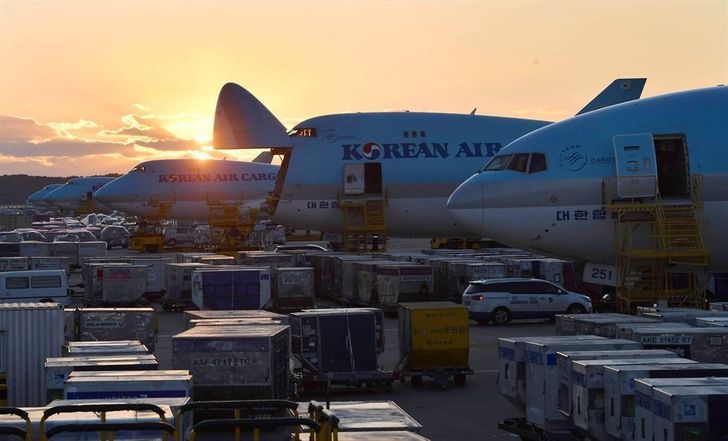
Korean Air's cargo planes are seen at Incheon International Airport, Dec. 16, 2020. Korea Times photo by Seo Jae-hoon
By Baek Byung-yeul
By Baek Byung-yeul
Concerns in the airline industry are growing as international oil prices are soaring and the value of the local currency is tumbling as the Korean won traded at around 1,200 won against the U.S. dollar.
Despite the airline industry's struggle with the impact of the COVID-19 pandemic, carriers were expecting to recover soon as the country prepares to shift to a phased return to normal. But industry analysts said it remains to be seen whether they can manage the impending risks.
An analyst here said Korean Air, the country's largest carrier, has weathered the crisis well by strengthening its air cargo business. But Korean Air has now been hit hard by soaring oil prices and a weakened won.
“The average jet fuel price soared 74 percent to $75 per barrel in the third quarter, compared to the same period last year. There is a possibility that it will act as a burden on future performance as the jet fuel price is deemed inevitable to rise further due to the recovery of air travel demand,” Kim Young-ho, an analyst at Samsung Securities, said.
“The exchange rate is also on a steep rise as the Korean won closed at 1,185 won against the U.S. dollar at the end of the third quarter, up 54 won from the end of the second quarter. Concerns are increasing over net losses due to the continued strength of the dollar,” the analyst added.
The strong dollar is attributed to a rise in demand for the mighty greenback, which is regarded as a safe asset amid growing uncertainties, such as inflation concerns caused by soaring international oil prices and tapering or the gradual reversal of quantitative easing.
When a strong dollar continues, the airline industry has typically seen profits drop. Most airlines rent aircraft and the rising dollar value increases debt to be paid back in the U.S. currency. Korean Air and Asiana Airlines said they will suffer 56 billion won and 34 billion won in foreign exchange valuation losses, respectively, if the value of the Korean currency rises by 10 won against the dollar.
Despite the rise in jet fuel prices, analysts said Korean Air and Asiana Airline will have to make up for losses through their air cargo businesses, which have shown steady demand.
“Though the third quarter is a traditional off-season, Korean Air continues to strengthen its air cargo business due to low supply compared to demand. Also, the company maximized its cargo capacity by operating 16 passenger airplanes as cargo planes,” Daishin Securities analysts Yang Ji-hwan and Lee Ji-soo said.