S-OIL bolsters ESG management
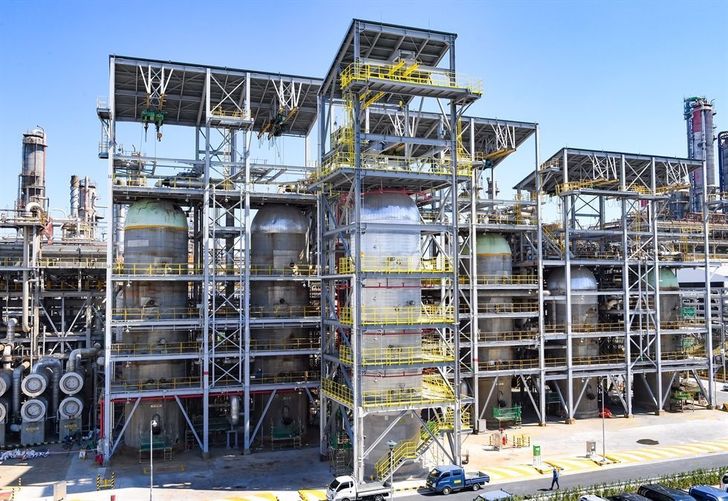
S-OIL's residue hydro-desulfurization facility in Ulsan / Courtesy of S-OIL
By Baek Byung-yeul
S-OIL is ramping up environmental, social and corporate governance (ESG) management by starting the operation of eco-friendly facilities to cut emissions, the refiner said Tuesday.
The company said it began operation of a residue hydro-desulfurization (RHDS) on March 20. Earlier the same month, the refiner began to run a vapor combustion unit (VCU). S-Oil invested 73 billion won into the expansion of the RHDS capacity and the construction of the VCU.
“The RHDS is an eco-friendly facility that curbs emissions during the process of producing fuels by removing impurities from high-sulfur residue oil used as feedstock through catalytic hydrogenation processes in high-temperature, high-pressure reactors,” the company said.
Thanks to the new facility, the residue oil quantity desulfurized by the newly build RHDS has increased by 18 percent to 40,000 barrels a day, from 34,000 barrels a day. Desulfurized residue oil turns into light fuels such as ultra-low sulfur diesel and naphtha by undergoing follow-up processes.
With the new RHDS, S-Oil expects the company will be able to respond swiftly to growing demand for high value-added marine fuel. “This, coupled with the improved efficiency and productivity of existing refining facilities, will raise the company's profitability by 40 billion won per year,” S-Oil said.
“We pushed forward with investment in the RHDS as part of our efforts to meet growing demand for low-sulfur marine fuel amid the IMO's tightening sulfur rules and to further commit ourselves to ESG management,” an S-OIL official said. Demand for low-sulfur marine oil is expected to soar as the International Maritime Organization's (IMO) regulation to limit ship sulfur emissions from 3.5 percent to 0.5 percent was implemented in January 2020.
The VCU is a green facility that prevents emissions of hazardous substances by capturing and completely combusting vapors emitted from storage tanks, the company said.
“We're planning on the construction of a larger-capacity VCU to prevent the leakage of vapors from crude oil and fuel storage tanks at our Ulsan refinery,” the company official added.