Nam Hyun-woo has worked as a staff writer at The Korea Times since 2013, mostly covering business and politics. He currently belongs to the Business Desk where he covers topics such as emerging tech, AI, ICT and Korea's chaebol community. Prior to joining the team, he was the paper's correspondent for the presidential office of Korea during the Yoon Suk Yeol and Moon Jae-in administrations.
POSCO to cut raw steel production on COVID-19
By Nam Hyun-woo
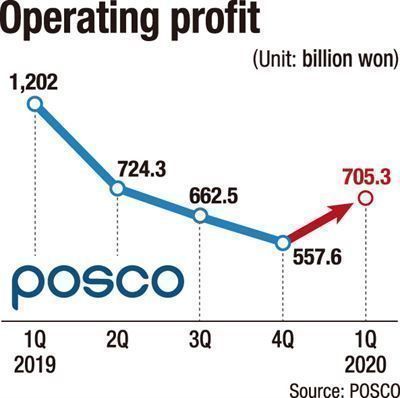
POSCO operating profit
By Nam Hyun-woo
POSCO said Friday it will cut production of raw steel this year due to the COVID-19 pandemic that is weighing heavily on demand worldwide.
During a conference call announcing first-quarter results, the company said it had adjusted its guidance on the production volume of raw steel this year down to 34.1 million tons from the 36.7 million tons it reported in January. The new figure is also 10 percent less than the 38 million tons the company produced last year.
Following the cut in production, the company slashed its sales prediction to 32.4 million tons from 35 million tons ― also reported in January ― as well as cutting this year's consolidated sales outlook to 57.54 trillion won from 63.79 trillion won.
“The damage in automobile plates is serious,” the company said. “Because our overseas units' primary customers are in the automobile industry, a decline in the share of automobile products' in overall sales is inevitable, especially in the second quarter. Thus, we will have to adjust our sales mix to make up for the decline.”
This is in line with the company's efforts to cope with a dive in global steel demand, especially in the automobile, construction and shipbuilding industries, in the wake of the coronavirus outbreak. The company said its 10 overseas plants would be shuttered until May, with the inevitable fiscal damage to its overall balance sheet.
“In the second quarter, demand from the automobile and construction industries will be uncertain, especially in North America, Europe and India,” POSCO said. “To cope with this, POSCO will employ aggressive cash flow management and protect profitability through preserving domestic sales and pre-emptive inventory management at overseas units.”
POSCO Chairman Choi Jeong-woo.
Posco said the cut in production would be “flexible,” depending on the market, but hinted at a further decline in steel output.
“The market circumstances will likely remain negative until the third quarter,” the company said. “We expect automobile industry operations to be back on track in the third quarter and this will lead to a recovery in the middle of the third quarter.”
Raw material prices are also spurring a grim outlook for POSCO's second quarter.
The company said iron ore prices were expected to be between $80 and $85 per ton in the second quarter, down slightly from $89 in the first quarter despite the COVID-19 outbreak. POSCO attributed this to world No. 1 mining firm Vale's plan to reduce output to 320 million tons this year, and China's solid demand for iron ore.
POSCO said it had secured more than 3 trillion won in new liquidity from October to January, so there would be no problem with cash flow, but the company would continue work at cutting costs.
Along with the adjustment in its sales outlook, the company also slashed its planned investment this year to 5.2 trillion won from 6 trillion won. However, POSCO said it would continue supporting subsidiary POSCO Chemical's anode and cathode material businesses, because they would be the steelmaker's new growth engine.
Due to the company's entrance into the electric vehicle (EV) battery material business, POSCO had been mentioned as a potential buyer of Doosan Solus, a producer of copper foil for EV batteries. However, the company denied this, saying, “Our battery business pursues organic growth, therefore we are not thinking of acquiring Doosan Solus.”
In the first quarter, POSCO's consolidated profit stood at 705.3 billion won, down 41.4 percent from last year. Sales also fell 9.2 percent to 14.54 trillion won from 16.01 trillion won. Net profit plunged 44.2 percent to 434.7 billion won.