Gov't, ruling party to salvage pandemic-hit industries
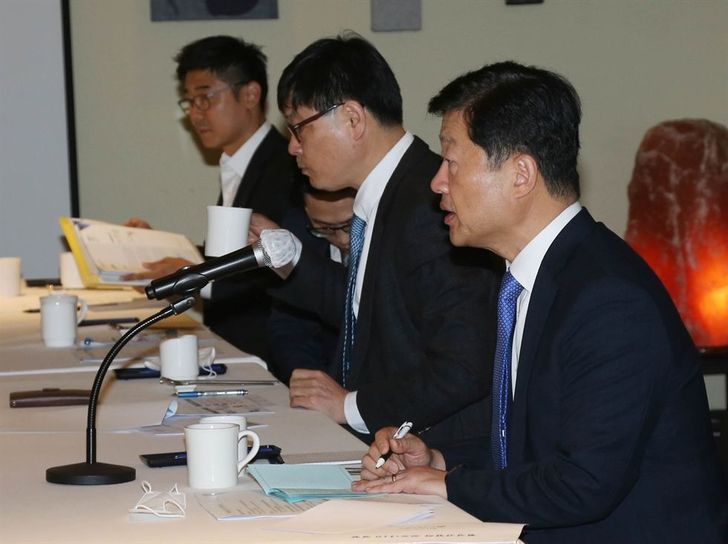
Korea Chamber of Commerce & Industry (KCCI) standing vice chairman Woo Tae-hee, right, speaks during a meeting along with representatives from five industrial associations in Gwanghwamun, Seoul, Thursday. Courtesy of KCCI
By Nam Hyun-woo
The government and lawmakers plan to expedite efforts to rescue domestic industries hit hard by COVID-19, after the general election, Wednesday, ended in a landslide victory for the ruling Democratic Party of Korea.
Business organizations have raised concerns with the government and lawmakers, urging them to provide extensive support for virus-stricken industries in the form of easing regulations, providing financial relief and introducing government-led industrial projects.
On Thursday, representatives from six leading business organizations held a meeting and requested the government to “become a relief pitcher” by infusing liquidity into companies.
The Korea Chamber of Commerce & Industry (KCCI), the Korea Automobile Manufacturers Association, the Korea Association of Machinery Industry, the Korea Iron & Steel Association, the Korea Offshore & Shipbuilding Association and the Korea Petrochemical Industry Association took part in the meeting.
They raised concerns that their industries will face a nosedive in the second quarter, and a growing number of companies will suffer a liquidity crunch, urging the government to take pre-emptive measures to prevent an industrial collapse.
“Due to the COVID-19 pandemic in the U.S., Europe and other major markets, global supply chains and automobile demand will suffer a shock from April,” the automobile association said. “The industry is in desperate need for policy-level support including expanded vehicle purchases by government arms, enhanced subsidies for eco-friendly vehicles, extended customer tax cuts for vehicles and the lifting of the regulations on online vehicle trading.”
The machinery association also urged the government to raise demand, asking for facility replacement at public research institutions and other government-run organizations. The steel association demanded the government to kick start planned public construction projects as well as new projects to replace old public water pipes.
The shipbuilding and petrochemical associations called for financial relief, such as extending the expiration of shipbuilding loans, infusing new funds and easing duties on petrochemical raw materials.
In general, the associations demanded the government ease regulations on labor, chemical and environmental issues, including flexible work hours and stabilized carbon credit prices.
“The reason that the Korean economy survived the past crisis was the fundamental power of manufacturing and other backbone industries,” KCCI standing vice chairman Woo Tae-hee said. “Following the COVID-19 outbreak, domestic companies are facing daunting difficulties to attract new clients amid a decline in exports which require inevitable aid from the government.”
Prompt relief packs
Following the businesses' calls, Industry Minister Sung Yun-mo on Thursday visited a mid-size steel processing firm, Kibo Steel, in Siheung, Gyeonggi Province, and promised the government will spare no effort in delivering pledged financial aid, such as primary collateralized bond obligations, to small- and medium-sized enterprises.
A day before the general election, President Moon Jae-in said the government planned to submit an additional supplementary budget to the Assembly soon after the vote, to provide prompt help for companies reeling from the COVID-19 fallout.
Last month, the National Assembly passed an 11.7 trillion won supplementary budget for the country to deal with the economic fallout of the coronavirus. On Thursday, the government approved an additional 7.6 trillion won extra budget which is focused on providing direct aid to households, with Prime Minister Chung Sye-kyun calling for “a prompt approval” by the Assembly.
As the ruling party has won a super-majority in the Assembly, the party's pledge to create the third COVID-19-related extra budget focusing on helping ailing companies will likely pick up speed.
More details on the government's support of industries is expected to be available after an emergency meeting on economic matters at Cheong Wa Dae next week. President Moon is expected to dropped hints that the government might help companies to pay wages for retained employees.
Despite the government's coronavirus aid plans, some companies expressed their doubts on the fundamental direction of the economic policies.
“The Moon administration has created many economic policies mostly affecting businesses, rendering it more difficult to run a company,” a conglomerate official said asking not to be named. “As the liberal ruling party consolidates its control on the Assembly, the Moon administration's existing economic policies will pick up momentum, and there would be no opposition voices strong enough to challenge the ruling party's policies burdening companies.”
Securing the fiscal balance is also a challenge for the new assembly and the administration.
When setting the first supplementary budget, the government decided to issue sovereign bonds worth 10.3 trillion won. For the second extra budget, the government came up with the money by cutting costs on social overhead capital and defense projects due to immense fiscal burden.
With the third extra budget expected to materialize, Korea's fiscal prudence will likely be an additional burden for the government. Last year, the government posted a 12 trillion won deficit in the consolidated budget balance; the first time since 2009 when the country was reeling from the global financial crisis.