'Faster drug development will save $3 mil. per day'
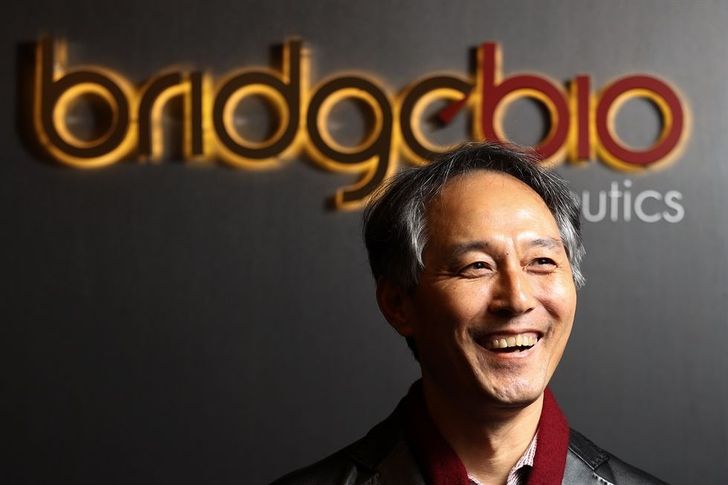
Bridge Biotherapeutics CEO Lee Jung-kue speaks during an interview with The Korea Times at the company's headquarters in Seongnam, Gyeonggi Province, Feb. 13. Korea Times photo by Choi Won-suk
Bridge Biotherapeutics eyes 'seller's market' in pharmaceutical value chain
By Nam Hyun-woo
There are a slew of biopharmaceutical firms that are operating here, with some even listed on the stock market, but not many of them are making a profit, as they have to make huge investments compared to the slim chance of bringing a new drug to market.
Thus, an operating profit by a young bio firm bears more significance than that of businesses in other industries, as it soothes investor concern over risks and provides proof that the company’s portfolio is solid.
One such firm is Bridge Biotherapeutics (Bridge), which recently garnered attention with a 617 million won ($519,000) operating profit and a 1.32 billion won net profit last year. It was an accomplishment that came just four years after the company was established in 2015, which is rare among biopharmaceutical firms in Korea.
Bridge CEO Lee Jung-kue attributed the success to the company’s business model of “no research development only,” which licenses in promising drug candidates, does early stage development and clinical studies, and then licenses them out to big pharmaceutical firms which will lead further development and manufacture the drugs.
Through this process, researchers who explored the candidate drugs do not have to handle the costly processes of commercialization by themselves, while big pharmaceutical firms can secure competitive drugs without the time-consuming research process.
“Developing a new drug is a race against time,” Lee said during an interview with The Korea Times, Feb. 13. “That is because the shorter the development period, the longer the selling period under the protection of patents. In terms of blockbuster drugs, with sales surpassing $1 billion, we say speeding up the development process by a day will save you $3 million.”
In setting drug patents, most of major markets in the world allow 20-year terms. Since it takes an average of 10 years to finish clinical trials and secure new drug approval, pharmaceutical firms have 10 years to sell finished drugs under patent protection. With a drug generating $1 billion in annual sales, a year-long delay in clinical studies costs the company about $1 billion, which translates to roughly $3 million per day. Due to this reality, many advanced drug markets have specialists handling different parts of a drug developing value chain to speed up the whole process, but there are not many development specialists in Korea.
“It is very much similar to the publishing industry,” Lee said. “Our job is finding authors with good stories and developing them into actual content, which involves layout, illustration and design. After this process, we sell this to a bigger publisher who will print the story into actual books and retail them.”
Lee said this business thus requires finding feasible and competitive drug candidates from research organizations.
“Our current focus is treatments for life-threatening diseases which have high, unmet medical demand,” Lee said. “Especially, we are looking into cystic fibrosis treatments and targeted cancer therapies which currently have a seller’s market, in which selling firms have the advantage.”
One such drug candidate was BBT-877 — aimed at treating Idiopathic Pulmonary Fibrosis (IPF), which led Bridge to post a turnaround last year.
In July last year, Bridge signed a 1.5 trillion won license-out deal with Boehringer Ingelheim over BBT-877 which was in Phase 1 clinical trials at the time. It was a feat that came two years after Bridge licensed the candidate from LegoChem Bioscience of Korea in May 2017, and one of the largest deals for a single compound involving a Korean biopharmaceutical firm.
Currently, Bridge has received approximately 60 billion won it set as an upfront and near-term milestone and it will receive up to 1.4 trillion won when the candidate reaches other milestones including clinical developments, approval and sales. Based on this trajectory, Lee assumed the company will reach 82.7 billion won in sales and 29.7 billion won in operating profit this year. “The market for IPF was valued at $2.2 billion in 2018, with two treatments only. Since the existing treatments have low efficacy and serious side effects, the outlook for BBT-877 is lucrative,” Lee said.
BBT-877 has a rival in the same class — GLPG1690 developed by Belgium-based pharmaceutical firm Galapagos. While BBT-877 has currently finished its Phase 1 study, GLPG1690 is in the middle of a Phase 3 study, with the goal of receiving approval from the U.S. Food and Drug Administration (FDA) by as early as 2022.
Since BBT-877 expects its approval in 2026, GLPG1690 is three years ahead, which is a great market advantage.
“Though BBT-877 is three years behind than GLPG1690, we believe Boehringer Ingelheim licensed our candidate because not only us but also Boehringer Ingelheim believe in the efficacy of BBT-877,” Lee said. “To minimize the impact of being late, we have done our best to shorten the development period and so has Boehringer Ingelheim.”
In general, it takes an average of 18 months for a drug developer to wrap up pre-clinical trials and file for an Investigational New Drug (IND) application with the FDA, which allows developers to test new drugs on people.
However, Bridge finished the same process in seven months for BBT-877 and took nine months for BBT-401, a candidate for ulcerative colitis treatment the company licensed out to Daewoong Pharmaceuticals in December 2018.
“We are a small company and I tend to give authority to my staff in many of our important decisions,” Lee said. “This allows Bridge to be agile and draw outcomes faster than large organizations which have bureaucratic processes they must meet.”
One license-in, one IND
Along with BBT-877 and BBT-401, the next candidate in Bridge’s pipeline is BBT-176, a targeted therapy for non-small cell lung cancer. After licensing it in December 2018, the company’s IND application was cleared by the FDA last month and it plans to launch a global Phase 1/2 study within this year.
“Just five years ago, big pharmaceutical firms showed little interest in targeted therapies, but they are emerging as a trend and resulting in a seller’s market. Our strategy is licensing in candidates with low interest and selling them out when big pharma shows demand,” Lee said adding he is currently looking into a number of candidates for eye diseases such as age related macular degeneration.
Looking ahead, Lee said Bridge will seek its goal of having one license-in deal and one IND application every year, so the company can secure five to six candidates in the pipeline and build the company’s capacity to pursue later stages of drug development.
“By expanding our pipeline to have five to six candidates at the same time in the next three years, we will organize a portfolio covering each clinical stage, and this will lower pending risks,” Lee said. “In the long-term, we hope to become a global specialty biopharma company developing specialty drugs and market them in the U.S. by ourselves.”