Nam Hyun-woo has worked as a staff writer at The Korea Times since 2013, mostly covering business and politics. He currently belongs to the Business Desk where he covers topics such as emerging tech, AI, ICT and Korea's chaebol community. Prior to joining the team, he was the paper's correspondent for the presidential office of Korea during the Yoon Suk Yeol and Moon Jae-in administrations.
Labor risks weighing on Kia, Renault, GM
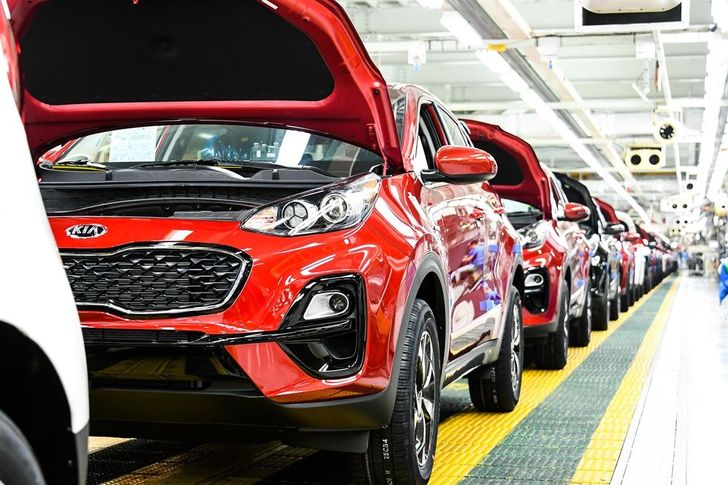
Kia Motors plant in Gwangju / Courtesy of Kia Motors
By Nam Hyun-woo
By Nam Hyun-woo
Kia Motors, Renault Samsung, GM Korea are grappling with renewed labor disputes, sending things from bad to worse for struggling local automakers amid soaring labor costs and sluggish sales, according to company officials, Thursday.
Officials stated that national vehicle manufacturing volume will likely sit below 4 million vehicles this year, and the number may decline further if automakers continue to be stalled by labor disputes and strikes.
According to Kia Motors, its Executive Vice President Choi Jun-young issued a statement to employees that he feels “miserable” over criticisms against Kia Motors unions' decision to go on partial strikes.
“The automobile industry is facing unprecedented changes and showing a sluggish new car sales amid global economic slowdown and protectionism,” Choi said. “This is not the time to be obsessed by wage negotiations. It is time to improve competitiveness and fix inefficiencies for our survival and stabilized employment.”
The union launched a series of partial strikes on Wednesday after its union members rejected a tentative agreement on this year's wage negotiation.
The tentative agreement included a 40,000 won hike in employees' base pay and a package of incentives. The unsuccessful plan was similar to a separate agreement Hyundai Motor management and a union amicably reached in September.
“The wage negotiation of Hyundai Motor serves as a standard for other carmakers in Korea,” an industry official said. “So other carmakers' negotiations were believed to be settled at similar level, but union members' demands have created a new risk for Kia Motors, which rolled out a slew of new cars recently and is in need of fast plant operation.”
Renault Samsung is also heading toward another round of labor disputes. Renault Samsung union members agreed Dec. 10 to strike in protest of this year's wage negotiation. The union will be in negotiation with management but could launch walkouts as early as Friday.
The Renault Samsung union has staged 312 hours of strikes over eight months since October last year in response to last year's wage negotiation. The losses incurred from the strikes amounted to 300 billion won, and the company's competitiveness in winning new orders from its headquarters has been significantly undermined.
GM Korea is facing a similar situation as its union appointed new leaders before wrapping up this year's wage negotiation. The union opposes management's plan to introduce a new shift system, threatening to take “full-scale action” if the company unilaterally introduces changes.
As the companies continue to suffer from labor disputes, analysts cast worries over the sustainability of the country's automobile industry.
According to the Korea Automobile Manufacturers Association, the country's car companies assembled 3.61 million vehicles from January to November. Given the current pace, the year-end output will likely remain below 4 million.
“The 4 million vehicle mark bears significance because it is the Maginot Line for the Korean automobile industry's survival,” said Kim Phil-soo, a professor at Daelim University's Automotive Engineering Department. “This is will also weigh down auto parts suppliers.”
Hyundai Research Institute expects the country's automobile output will decline to 3.87 million vehicles in 2020, down from this year's estimated 3.96 million.