Kwak Yeon-soo is a digital editor at The Korea Times creating, editing and curating digital content for the newspaper’s website, mobile app and social media. She previously covered a diverse array of cultural, political and business topics.
Global players descend upon Korea's ice cream market
By Kwak Yeon-soo
By Kwak Yeon-soo
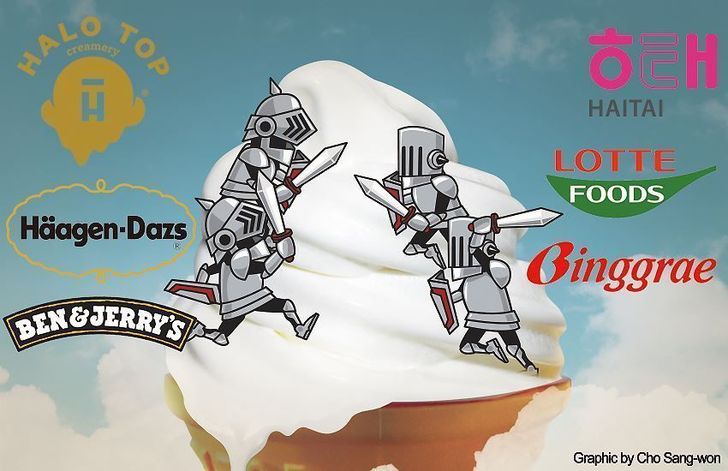
Ben & Jerry's and other global ice cream brands are descending upon Korea, targeting increasingly health-conscious consumers here looking for something different, according to industry officials Tuesday.
They are on a collision course with Binggrae and other home-grown ice cream makers who vow to defend their territory against the larger multinational players.
In July, the first pints from Los Angeles-based Halo Top Creamery went on sale in Korea. The company brought only three of the 24 dairy flavors it sells in the U.S. The three flavors range between 285 calories at the lowest for birthday cake and 330 at the highest for peanut butter cup.
Also in August, Vermont-based Ben & Jerry's started selling its ice cream in grocery stores. It sells four flavors here ― chocolate chip cookie dough, chocolate fudge brownie, vanilla and chunky monkey.
It planned to debut in Korea in October, but decided to pull up the official launch date after it recorded higher sales figures than it had expected here.
“We consider all dessert ice cream makers as our competitors, including Haagen-Dazs, Natuur and Halo Top,” a Ben & Jerry's official said. “However, Ben & Jerry's uses all-natural ingredients in the making process, including dairy products from cows that are raised without the use of recombinant bovine growth hormones.”
Although international brands make up only a small proportion of the industry given that they have been operating for less than two months, their impact should not be underestimated, officials said.
According to data provided by 7-Eleven, premium ice cream sales in the overall ice cream category accounted for 23.6 percent in 2019, up 5.2 percentage points from a year ago.
“Premium ice cream sales grew 12.9 percent year-on-year, driving the overall ice cream growth to 6.8 percent,” a 7-Eleven official said.
“Compared to the past when low-cost, classic ice creams were popular, consumers want more nutritious options that still taste good.”
The official said the premium ice cream market will likely expand in the future instead of international brands taking away local ice creams' market share.
The domestic pint ice cream market is led currently by Binggrae, which owns ice cream brand Together with a market share of 35 percent. It is followed by Lotte Confectionery (20 percent), Haitai Confectionery & Foods (15 percent) and Lotte Foods (11 percent). Currently, Haagen-Dazs is the largest global ice cream brand here, accounting for 8.7 percent of the market.
Binggrae has been strengthening its marketing efforts by operating pop-up stores and releasing miniature pints to renew the old brand image of Together.
It ran a pop-up store called Together Picnic House in Yeonnam-dong from June 19 to July 7, holding various events such as art printing and a self-photo studio, to target young consumers.
It also released a mini-cup version of Together to meet the trend of single-person households.
“Since its launch in 1974, Together has been a steady seller among ice cream lovers,” a Binggrae official said. “We will seek diverse marketing shifts to revitalize the brand image and appeal to younger consumers.”