Kwak Yeon-soo is a digital editor at The Korea Times creating, editing and curating digital content for the newspaper’s website, mobile app and social media. She previously covered a diverse array of cultural, political and business topics.
'Brick toys boost creative thinking in children'
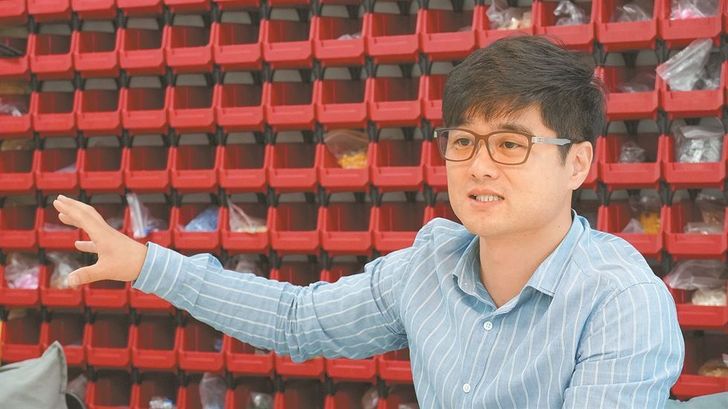
Ansbrick CEO Jimmy Heo speaks during an interview with The Korea Times at his office at Pangyo Techno Valley, July 12. / Courtesy of Ansbrick
By Kwak Yeon-soo
By Kwak Yeon-soo
Unlike typical toy designers who say that they have dreamed of entering the profession from a young age, Ansbrick CEO Jimmy Heo did not actually think it was a real career option.
Instead, he pursued a career as a product developer, designing TVs, computers and robot vacuum cleaners at an electronics company.
“I've always had an interest in engagement marketing and creating a business model that could appeal to both children and adults,” Heo said in an interview with The Korea Times.
“At first I came up with wood crafts, but many feared it would be too dangerous for kids to play with wooden blocks. So, I switched to brick toys.”
According to Heo, anybody can design or manufacture a brick toy. But commercializing it is a whole different story.
“There's an unbeatable brick giant called Lego. Who'd want to compete with the Danish firm?” Heo said. “The toy brick business also requires a lot of resources and inspiration.”
Being aware of the hurdles, Heo went to China to buy 600 different kinds of tiny brick pieces. There are limitless ways to combine 600 bricks into a variety of forms.
“Why China? That's where you can find a large selection of brick toy manufacturers and products of high quality,” he said.
“The Chinese suppliers rejected my offer for three months, but I persuaded them and was finally able to import blocks to Korea.”
By the time he founded Ansbrick in 2015, Nanoblock was seeing a big boom in Korea. Riding on the trend, Heo and his team manufactured a private label product and then partnered with big firms, like Netmarble and Kakao, to develop brick toys that resemble their characters.
“I was lucky because when I first started the business, nano blocks were widely popular here,” Heo said. “Large firms were also looking to manufacture them.”
Car companies and air carriers later became Ansbrick's clients later on, requesting miniature brick versions of their cars and airplanes.
“I enjoy working on a variety of projects and providing on-demand services to our clients,” he said.
Heo described his creative process: “I usually sketch the concept on the computer and then articulate a detailed, step-by-step manual so that children can follow the instructions.”
He added, “When you're building a brick toy, it must be stable, meaning the blocks should not fall off easily, and it has to be enjoyable to build.”
The Pixel Friends developed by Ansbrick / Courtesy of Ansbrick
For the company's next big project, Heo said they are currently working on developing a 3D VR/AR app as kids have moved toward playing more digitally than they did a decade ago.
“I've been incorporating AR/VR technology to brick toys and I hope it'll create fun in children's lives,” he said.
“The focus is on digital experiences and how technology can be used to create more engaging experiences for children.”
He explained that the app will be targeted at children aged five to eight for now. “Between five and eight is when children begin to understand spatial relations and exercise their creativity. We will offer projects to help them grow as critical thinkers.”
Heo also shared his wish to produce a regular science, technology, engineering and math (STEM) subscription box for children.
“In the U.S., there are already a lot of companies that are selling subscription boxes. A child may build with toy bricks using all the components inside the box,” he said.
“We have about four employees located in the U.S., who are working on product design and development. They keep track of the most recent trends in children's games and play activities,” he said. The other eight members are stationed in Korea.
Heo said that Korean consumers differ from U.S. consumers in that they are prone to always look for new products and services.
“Compared with U.S. consumers, Koreans begin to feel fatigued by repetitive content,” he said.
Heo recalled that the stand-out moments while working as a toy designer were when his projects were well-received by his daughter.
“I usually test ideas with my daughter and change elements based on her feedback to ensure the new projects are perfect for children,” he said.
As the CEO of a company that builds toy culture, Heo said that hands-on activity is every child's instinct.
“Early hands-on activities, which include building brick toys, are an essential part in every child's life because these activities can later develop into raising one's interest in sports and education,” he said.
“The act of doing something is a lot more important than one can imagine.”