Kwak Yeon-soo is a digital editor at The Korea Times creating, editing and curating digital content for the newspaper’s website, mobile app and social media. She previously covered a diverse array of cultural, political and business topics.
Hyundai Heavy shareholders approve split-up plan
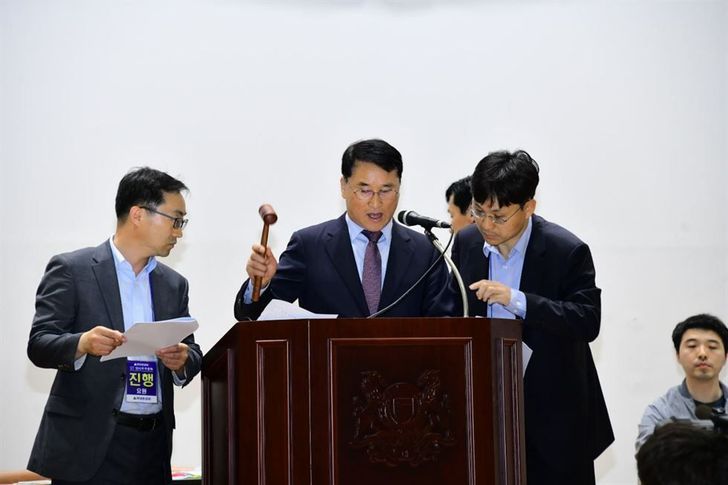
Hyundai Heavy Industries CEO and President Han Young-seok, center, announces shareholders' approval of the company's split-up proposal in their meeting held in a gymnasium at the University of Ulsan, Friday. Courtesy of Hyundai Heavy Industries
By Kwak Yeon-soo
Union vows to take legal action to nullify decision
By Kwak Yeon-soo
Shareholders of Hyundai Heavy Industries (HHI) approved the company's split-up proposal to pave the way for the takeover of Daewoo Shipbuilding & Marine Engineering (DSME) amid strong opposition from its union, the company said Friday.
With the shareholders' approval, Korea's largest shipbuilder will be divided into Korea Shipbuilding & Offshore Engineering, a sub-holding company merging parts of HHI with DSME, which will carry out shipbuilding and offshore businesses, and a reorganized HHI.
The reorganization move came after HHI signed a formal deal with the state-run Korea Development Bank in March to buy DSME.
“The physical division is intended to enhance the competitiveness of HHI by taking over DSME. We will do our best to continue to lead the company's growth and maximize shareholder value,” HHI CEO and President Han Young-seok said.
The shareholders' meeting was met with a fierce backlash from the HHI union. Union members confronted company officials and the police in Ulsan in front of the Hanmaum Center, the scheduled venue, to prevent shareholders from entering the building.
As a result, HHI changed the time and venue for the meeting to a gymnasium at the University of Ulsan.
The union members continued their sit-in protest, but later damaged doors and buildings at the University of Ulsan, as they tried to enter the meeting venue to prevent a vote.
“Today we've done everything we can, but we won't stop here. We will seek legal action to nullify the shareholders' decision,” a Korean Metal Workers' Union official said.
The labor-management conflict at HHI has been escalating as the union intensified its opposition to the company's decision to take over DSME.
The HHI union has been staging walkouts in Seoul and its headquarters in Ulsan since mid-May and the protests have turned into violent clashes at times.
The union has been opposing the split-up plan, claiming the split will force the reorganized HHI to inherit massive debts that will lead to job cuts.
It also fears the possible moving of the headquarters of Korea Shipbuilding & Offshore Engineering may lead to transferring of facilities in Ulsan to other cities.
Union workers of Hyundai Heavy Industries, right, confront company officials in Ulsan, Friday, in front of the Hanmaum Center, the scheduled venue of the company's shareholders' meeting. Yonhap
HHI denied this, saying even after the restructuring, the company will continue operating without transferring workplaces to other cities. The shipbuilder added it is highly efficient for the sub-holding company to be headquartered in Seoul in order to serve as a control tower and attract R&D personnel.
“We will do our best to rebuild mutual trust and bring stability to labor-management relations. It is vital to eliminate misunderstandings and doubts from union workers and Ulsan citizens in order to strengthen our competitiveness,” a HHI official said.
Along with the union's opposition, approval from global antitrust authorities will likely be another hurdle for HHI to overcome, given previous cases of takeovers or mergers and acquisitions being blocked for failing to address competition concerns.
The company faces strict international scrutiny from foreign antitrust authorities over the new entity's monopolistic status. At the end of last year, HHI and DSME won a combined 21 percent of global orders.
Apart from winning approval from Korea's Fair Trade Commission, the company has to pass review processes in China, Japan and the European Union among others, because the new entity could reshape the global shipbuilding industry.