Kwak Yeon-soo is a digital editor at The Korea Times creating, editing and curating digital content for the newspaper’s website, mobile app and social media. She previously covered a diverse array of cultural, political and business topics.
Hyundai Motor builds hydrogen station at National Assembly
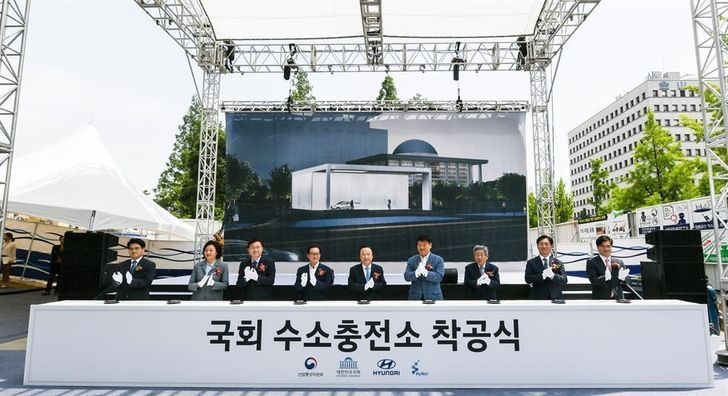
Minister of Trade, Industry and Energy Sung Yoon-mo, second from right, Minister of SMEs and Startups Park Young-sun, second from left, Hyundai Motor President Kong Young-woon, right, and other guests applaud at a groundbreaking ceremony for Hyundai Motor's hydrogen filling station next to the National Assembly building in Seoul, Thursday. / Courtesy of Hyundai Motor
By Kwak Yeon-soo
By Kwak Yeon-soo
Hyundai Motor will build a hydrogen filling station next to the National Assembly building to encourage the use of hydrogen fuel cell electric vehicles (FCEV), the company said Thursday.
This comes as the Moon Jae-in administration is stepping up efforts to protect the environment by promoting the use of cars running on sustainable power sources.
The commercial hydrogen filling station, taking up a total area of 1,236.3 square meters, will be the first to be built in Seoul or at a government building and is hoped to lead to more widespread use of FCEVs.
Construction of such a facility normally takes from eight to 10 months, but the automaker said it will complete it by the end of August. The company is being supported by the government, the National Assembly and the Ministry of Trade, Industry and Energy.
The hydrogen station will have a supply capacity of 25 kilograms of hydrogen per day, which can refuel five or more FCEVs per hour, or a total of 70 during its opening hours which will be from 8 a.m. to 10 p.m.
“The government, the National Assembly and the trade ministry eased regulations to encourage the construction of the hydrogen station,” a Hyundai Motor official said.
“Hyundai Motor is planning to expand the hydrogen infrastructure so that Korea will become a leader in the use of FCEVs, by constructing a city-center filling stations not just supplying more hydrogen-powered vehicles,” the official said.
Some members of the National Assembly and two ministers participated in the groundbreaking ceremony to mark the shift toward an alternative fuel infrastructure.
“By installing a hydrogen filling station at the National Assembly, we hope to relieve public concerns over their safety,” Industry Minister Sung Yun-mo said.
In January, the industry ministry unveiled its “hydrogen economy drive,” aimed at using hydrogen as the main alternative fuel source for cars.
The government expects the number of hydrogen charging stations to grow gradually, from 14 last year to 310 by 2022.
Hyundai has sold 9,057 Nexo FCEVs since its launch in March 2018. The company also plans to produce 5,500 cars domestically this year and increase production next year in line with the government's roadmap.