Chaebol cornered by 'ruinous' inheritance tax
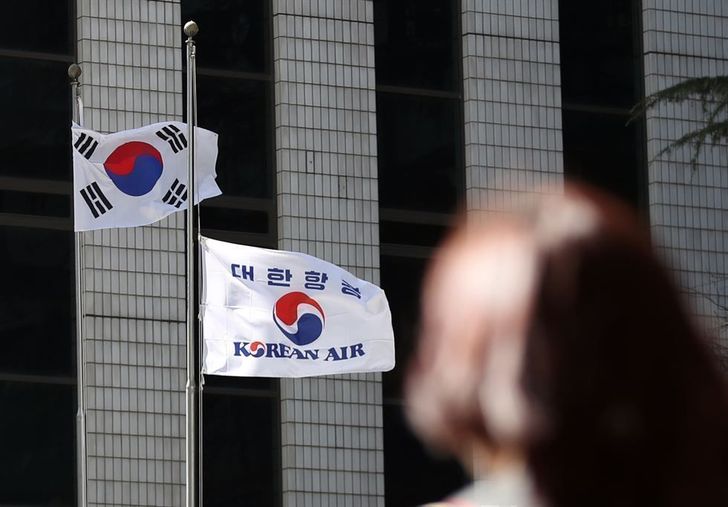
The flag of Korean Air, a Hanjin Group unit, is at half-mast at Korean Air office in Jung-gu, Seoul, Monday, to commemorate Group Chairman Cho Yang-ho's death. Yonhap
Cho's death sheds new light on Korea's 50% tax rate
By Nam Hyun-woo
Concerns are growing that Korea’s inheritance tax is a major risk for business communities, after Hanjin Group Chairman Cho Yang-ho died and his family had to pay nearly 200 billion won ($175 million) in tax to inherit the late chairman’s stake and keep control of the group.
Industry analysts stressed Tuesday that most Korean businesses are family-controlled and the current maximum 65 percent rate is a huge pressure on companies, hampering their business activities.
According to Korea Economic Research Institute, Korea imposes a 50 percent tax on a person inheriting assets worth more than 3 billion won. When the inheriting asset is a controlling share of a company, the value of the share increases by 20 to 30 percent, thus pushing up the maximum rate to 65 percent.
This makes Korea the highest levying country among OECD member countries, whose average inheritance tax is 26.3 percent.
Due to this, the offspring of the late Hanjin Group chairman will have to pay between 160 billion won and 200 billion won to keep Cho’s 17.84 percent stake in Hanjin KAL, the group’s holding company, and other shares in group units.
Otherwise, the family may lose its managing rights to private equity fund KCGI and the National Pension Service (NPS), which have been hostile to the owner family’s grip on the group.
There have been multiple cases where the founding family of a group have lost their managing rights due to massive inheritance tax.
In 2017, Lee Woo-hyun, vice chairman of domestic chemicals firm OCI, sold a part of the company’s controlling stake he received from his father and the late former Chairman Lee Soo-young, due to the inheritance tax amounting to 200 billion won.
This made the younger Lee the third-largest stakeholder in the company, and he became No. 2 last year.
Three Seven, a company making nail clippers, even sold the company’s whole stake to JW Holdings in 2008 because the bereaved family of the late founder Kim Hyung-kyu could not handle the 15 billion won inheritance tax.
“Korea’s inheritance tax is too high,” said Oh Moon-sung, a professor at Hanyang Women’s University. “Under this structure, Korean firms are prone to losing managing rights during generational shifts. If lowering the tax rate is difficult, payment of taxes on firm’s stakes can be delayed until the inheritor sells off the stakes.”
The country is providing discounts on inheritance tax to companies meeting certain requirements, but Oh also said those requirements are very tough for a general company to meet.
Cho Dong-keun, an emeritus professor at Myongji University, said that the country’s hefty inheritance tax is hampering companies from doing businesses, and Korea should follow other countries which have delayed, cut or abolished inheritance tax.
“It is a big risk for companies,” he said. “Along with the recent movement of the NPS’ recent shareholder activism, the high rate will discourage more and more companies in doing businesses.”