Nam Hyun-woo has worked as a staff writer at The Korea Times since 2013, mostly covering business and politics. He currently belongs to the Business Desk where he covers topics such as emerging tech, AI, ICT and Korea's chaebol community. Prior to joining the team, he was the paper's correspondent for the presidential office of Korea during the Yoon Suk Yeol and Moon Jae-in administrations.
Retailers set to sever biz ties with credit card firms
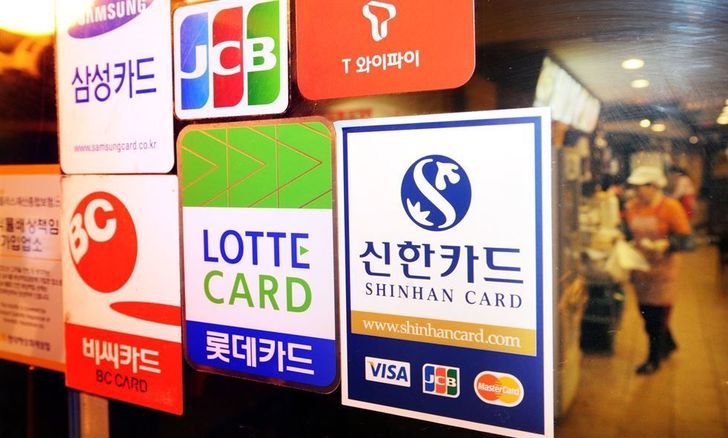
Seen above are stickers showing credit card partnership at a restaurant in Myeongdong, Seoul, in this file photo. Korea Times file
By Nam Hyun-woo
By Nam Hyun-woo
Discount store chains, department stores and other retailers will likely sever their memberships with credit card issuers to protest the latter's fee hike, saying the move will end up triggering consumer price hikes, according to company officials Tuesday.
The country's top telecom companies _ SK Telecom, KT and LG Uplus _ have been in contract negotiations with credit card issuers over the latter demanding a hike to an average 2.1 percent from the current 1.8 percent, the officials said.
The telecom companies have been negotiating with the card issuers since January, when card issuers notified their 23,000 affiliated members of their plan to raise transaction fees.
The talks were supposed to end last month, with the increase to be applied from this month, but no agreement has been reached, with sources saying firms are refusing to accept the card firms' demand.
“The negotiations are prolonged because telecom companies and card issuers are refusing to compromise,” an industry source said. “With both sides sticking to their guns, negotiations will likely continue until the end of the month, and the worst case scenario of telecom firms cancelling their memberships could take place.”
The situation is similar among large discount chains. Big names including E-mart, Lotte Mart and several other department stores are balking at card issuers raising their fees from the current 1.9 percent to 2.1 percent.
“If the talks fail, there would be cases following Hyundai Motor's exit from credit card memberships, while several other firms will make significant hikes in consumer prices,” a discount chain official said.
On Monday, Hyundai Motor and Kia Motors ended their contracts with five domestic credit card companies to protest the fee hike. As a result, Hyundai Motor and Kia Motors dealers will not accept cards issued by Shinhan, KB Kookmin, Samsung, Lotte and Hana Cards from March 10.
Retail businesses argue that the credit card firms have no grounds to impose the increase.
Credit card firms calculate fees depending on their costs for securing funds, risk management and marketing. Among these, the interest that card firms pay for securing funds is cited as the basis of the fee.
According to card firms' financial data, the interest rate paid by the country's No. 1. card issuer Shinhan Card was set at 2.8 percent for the 2015 to 2017 period, down from the average 4.29 percent during 2012 to 2014. This shows that the card firm was securing loans at lower interest rates, thus decreasing its costs. KB Kookmin Card also saw a 0.9 percentage points drop in its interest payments during the same period.
According to a report from the Credit Finance Association, the average annual interest rate paid by domestic card issuers fell to 2.31 percent in 2017 from 3.66 percent in 2013, with theirs cost declining 210 billion won to 1.61 trillion won during the same period.
“We have demanded card issuers explain this, but no firm has given a clear explanation,” a Hyundai Motor official said.
The reason card firms are pressuring retail giants is their revenue from card fees is expected to decline.
Following the government's regulation forcing card firms to cut their fees for small companies with less than 50 billion won in annual sales, they forecast a 580 billion won decline in revenue from fees. If card firms increase fees by an average 0.3 percentage points for large firms, it will generate approximately 500 billion won in revenue.
This is not the first time that card firms and retail companies have clashed over card fees. In 2004, E-mart severed its contract with BC Card after the card firm raised its transaction fee to 2.3 percent from 1.5 percent. This triggered a massive backlash from consumers and BC Card adjusted the hike to 1.85 percent.