POSCO Daewoo to run grain terminal in Ukraine
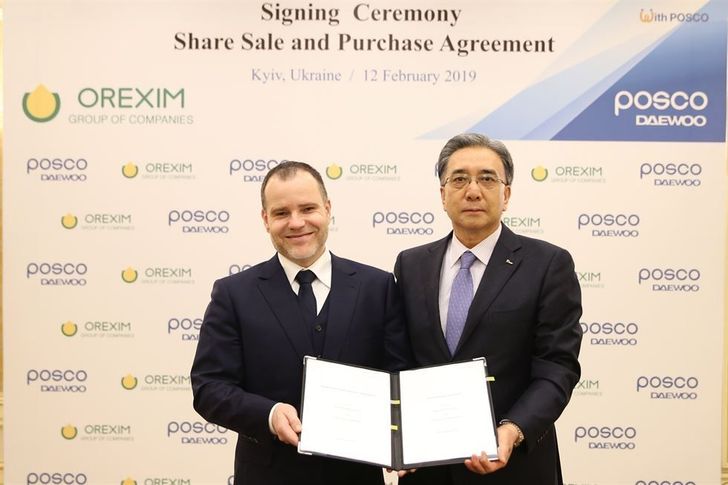
POSCO Daewoo CEO Kim Young-sang, right, holds an MOU with Orexim Group Chairman Yuri Budnyk in Kyiv, Ukraine, Tuesday. Courtesy of POSCO Daewoo
By Nam Hyun-woo
POSCO Daewoo will run a grain export terminal in Ukraine, becoming the first Korean firm to operate an overseas grain terminal contributing to Korea's food security, the trading firm said Wednesday.
According to the company, it signed a deal with Ukraine's Orexim Group over acquiring a 75 percent stake in the terminal in the port of Mykoliv in southern Ukraine, which is one of the main export hubs around the Black Sea. It did not reveal the amount of the deal.
The terminal is currently under construction with plans for completion in July this year. It will be capable of shipping up to 2.5 million tons of goods in a year.
Orexim Group is one of Ukraine's leading logistics companies, having multiple logistics units under its wing. The group exported 1.4 million tons of sunflower seed oil in 2017, accounting for 30 percent of the total outbound sunflower oil shipments of the country.
By acquiring the rights, POSCO Daewoo can have logistics control over a significant amount of Ukrainian grain coming into the terminal. Approximately 22 percent of Ukraine's grain exports is going out through the Mykoliv port, according to POSCO Daewoo.
Ukraine is one of the emerging grain exporting countries in the world, with its food production volume doubling to 77 million tons in 2017 from 40 million in 2007. Of them, exports increased fivefold to 43 million tons from 8.5 million tons during the same period, making the country the world's No. 4 exporter of corn and No. 6 for wheat.
According to the United States Department of Agriculture, Ukraine's grain exports will reach 75 million tons in 2027, attracting not only major grain companies including Cargill of the U.S. and Glencore of Switzerland but also Japanese trader Sumitomo to invest into the country's agricultural industry.
“The project was carried out as one of the 100 tasks announced by POSCO Group Chairman Choi Jeong-woo,” a POSCO Daewoo official said. “This also has significant meaning as it contributes to the country's food security in a potential worldwide food crisis.”
As of 2017, Korea's self-sufficiency rate is 48.9 percent, far below leading countries such as Argentina with 273 percent, Uruguay with 232 percent, and Ukraine with 193 percent. When it comes to grain, Korea's rate plunges to 23.4 percent, far below OECD nations' average of 85 percent.
Especially, Korea's corn and wheat self-support rate is remaining below 2 percent, importing 10 million tons of corn and 5 million ton of wheat in 2017.
Since POSCO Daewoo is operating the terminal, it can control the amount of grain purchase, storage and the order of shipping, thus having a capability to help improve Korea's food security.
The project is also in line with the Presidential Committee on Northern Economic Cooperation's plan to improve economic relations with Eurasian countries.
“POSCO Daewoo aims to become Korea's largest food resources company capable of handling 15 million tons of food and is working on building a food value chain starting from the farm to logistics,” the official said.