Renewed NAFTA weighs on Kia Motors
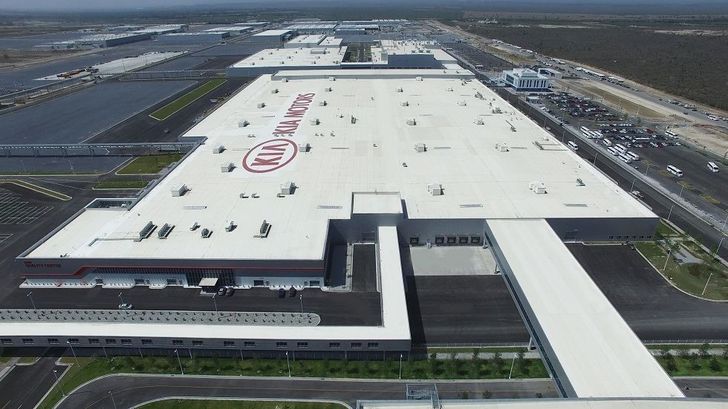
Kia Motors' factory in Mexico / Courtesy of Kia Motors
By Park Jae-hyuk
Kia Motors will face rising manufacturing costs because of the new trade deal signed among the United States, Mexico and Canada, according to the Korea International Trade Association (KITA).
According to the association's recent report, stricter regulations on vehicles imported to the U.S. will weigh more on foreign carmakers exporting vehicles from Mexico and Canada to the U.S.
The new U.S.-Mexico-Canada Agreement (USMCA) requires 75 percent of auto parts to be built in the three countries, up from the current 62.5 percent. At least 70 percent of steel and aluminum used in the cars should also be made in the North American countries. In addition, at least 40 percent of components of passenger cars and at least 45 percent of components of trucks should be made by workers earning $16 an hour.
Up to 2.6 million passenger cars satisfying the new regulations will be exempt from a 25 percent tariff based on Section 232 of the U.S. Trade Expansion Act.
Section 232 allows U.S. President Donald Trump to impose unlimited tariffs or create other trade barriers at his discretion if he believes they are needed so that “imports will not threaten to impair national security,” which is expansively defined in the section. Trump has threatened to impose a 25 percent tariff on all cars exported to the U.S.
The KITA regards the regulations as measures to press Korean, Japanese and German carmakers to expand their productions in the U.S.
For the past few years, global automakers have built manufacturing facilities in Mexico, where they can save costs for producing cars to be exported the U.S. market. Workers at car factories in Mexico are paid $7 an hour on average, while those who work for factories in the U.S. and Canada get $20.
Kia has run a factory with an annual production capacity of 400,000 vehicles in Pesqueria in the northern Mexican state of Nuevo Leon since 2016, taking advantage of lower labor costs in the country and the North American Free Trade Agreement that took effect in 1994. Korea's second-largest carmaker has produced 290,000 cars at the factory and exported 60 percent of them to the U.S.
The company said it will make a strategic decision when more details of the USMCA come out.
The KITA urged the government to make every effort for to ensure Korean vehicles are exempt from car tariffs, because the country is expected to face the rapidest decline in car exports, if the U.S. imposes the hefty tariffs.
According to the KITA, Korea's car exports will likely decrease by 22.7 percent in case of the imposition, while those of Japan, China and Germany will likely drop by 21.5 percent, 21.3 percent and 21 percent, respectively.
In 2017, Korea exported vehicles and auto parts collectively worth $24 billion to the U.S. The amount was 1.6 percent of the country's GDP that year.
“To avoid a decline in exports, the government needs to persuade the U.S. into excluding Korea from countries subject to Section 232,” a KITA researcher said. “It should also make efforts to diversify the market, secure competitiveness in technology and enhance the global value chain.”