Park Jae-hyuk is a seasoned journalist who has provided comprehensive coverage of South Korea's corporate dynamics, economic policies, industry challenges and the global positioning of Korean companies. Based on the articles he has written since joining The Korea Times in 2016, his investigative approach has helped readers understand corporate governance, economic trends and business strategies shaping South Korea’s economy.
Moral hazard prevalent in DSME union
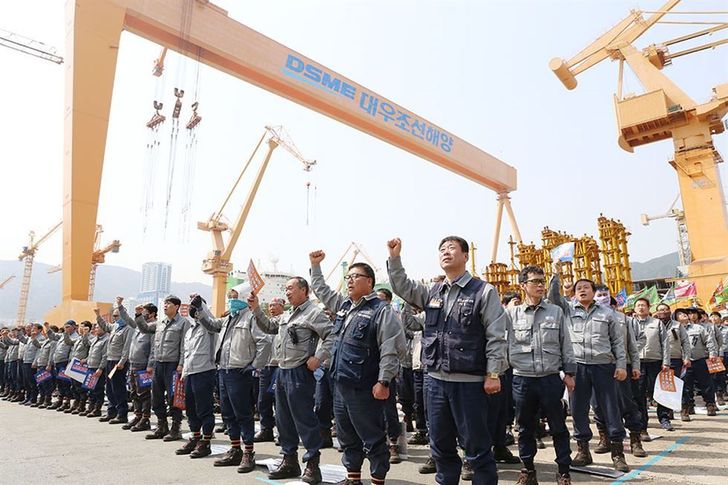
Daewoo Shipbuilding Workers Union members raise their fists during a ceremony for collective bargaining at the shipbuilder's shipyard in Geoje, South Gyeongsang Province, March 29. On Tuesday, the unionized workers voted to strike. / Courtesy of Daewoo Shipbuilding Workers Union
By Park Jae-hyuk
By Park Jae-hyuk
Daewoo Shipbuilding & Marine Engineering's (DSME) militant union is facing severe criticism for breaking its promise not to get into a labor dispute until the shipbuilder's recovery from a liquidity crunch, industry officials said Friday.
On Tuesday, Daewoo Shipbuilding Workers Union voted to strike over stalled wage talks. According to the union, 4,811 union workers among 5,883 cast their ballots from Monday to Tuesday, and 4,494 voted for the strike.
The union cited the company's turnaround last year and the basic monthly wage which has been frozen for four straight years as reasons for the necessity of a wage increase.
“The recent vote showed our members have been dissatisfied with the company's self-reform plan,” the union said in a statement. “If the management reiterates its argument, we have no choice but to go on a strike.”
When the government invested 13.7 trillion won ($12.2 billion) into the shipbuilder's recovery, however, the union submitted a written pledge to the Korea Development Bank (KDB), promising it would stop feuding with management to help the company bounce back.
Considering the huge amount of taxpayers' money that has been used to save the shipbuilder, the union is struggling to avoid public criticism for its moral hazard, according to industry officials.
They also said last year's temporary turnaround was a result of the injection of government funds worth 2.9 trillion won, not from the unionized workers' devotion to their company.
What is worse, the shipbuilder posted 351 billion won in operating losses in the fourth quarter last year. Its sales have continued to decline as well, because it received few orders between 2016 and 2017.
The KDB is maintaining its firm stance that it can take action against the strike ― regardless of its legitimacy ― if it interferes with the shipbuilder's business.
“The government has behaved inappropriately, as it has been afraid of DSME's bankruptcy, which may eliminate 50,000 jobs and lead to a shutdown of 1,300 subcontractors,” a shipbuilding industry official said. “The union has been making unreasonable demands, taking advantage of the labor-friendly government.”
The management has rejected the union's demand, as it was ordered to secure 5.9 trillion won until 2020.
DSME raised 2.8 trillion won last year by selling assets and cutting personnel expenses. This year, it plans to raise an additional 1.3 trillion won by selling domestic assets and overseas subsidiaries. The company also demanded its workers return 10 percent of their basic wages to fulfill the self-reform plan.
Unlike Hyundai Heavy Industries and Samsung Heavy Industries, both of which seek for survival through a capital increase by issuing new stocks, DSME is still dependent on support from the KDB and the Export-Import Bank of Korea.
However, the DSME union voted last month to join the Korean Metal Workers' Union, the most militant umbrella union in the country. Industry officials regard the union's decision as a declaration of war against management.