Lotte, Orion grappling with falling consumption
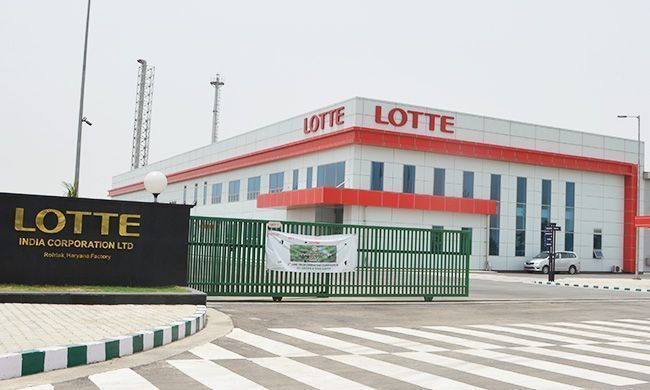
Lotte Confectionary’s plant in New Delhi, India. / Courtesy of Lotte Confectionary
By Lee Hyo-sik
Lotte, Orion and other confectionary firms here have fallen victim to the prolonged consumption slump as consumers spend less on snacks and other non-essential food items amid soaring household debt and stalled income growth.
Intensifying competition has also chipped away at the firms’ profitability as they lowered prices to woo buyers.
Company stocks have been battered by declining sales and worsening bottom lines over the past few years, forcing them to head overseas to find new sources of income.
However, it has not been entirely easy for local snack makers to do business abroad.
Many have established a presence in China but sales growth seemed to have slowed as the confectionary market there has matured in line with the declining youth population.
In addition, China’s recent retaliation against Korea over the latter’s decision to deploy the U.S. Terminal High Altitude Area Defense system is feared to have made it more difficult for Korean companies to do business in mainland China.
“We don’t know yet whether our 2016 sales fell from 2015. But in the first nine months of 2016, the sales declined from the corresponding period a year earlier,” a Lotte Confectionary official said. “The prolonged economic slump and the demographic changes have been unfavorable for our business. Given the shrinking domestic market, we had no choice but to make inroads into foreign markets.”
Lotte operates plants in seven countries: China, Vietnam, India, Pakistan, Russia, Belgium and Kazakhstan, according to the official, who said its overseas business has been faring relatively well. “Many have raised concerns over the growing anti-Korea sentiment in China. But as far as I know, our business there has not had any fallout.”
Orion’s plant in Ho Chi Minh City, Vietnam. / Courtesy of Orion
Orion, which is widely known for its chocolate-coated biscuit brand Choco pie, also echoed Lotte’s view, projecting that its 2016 sales would likely have contracted for the fifth consecutive year since 2012.
“Our domestic sales have been declining over the past few years as consumers buy less snacks and other non-essential food items amid the economic slump,” an Orion official said. “The rapid population aging has also weighed down on our performance. But in 2017, we expect a sales increase largely on a technical rebound.”
The official said the firm’s China business has slowed, but still its sales have continued to expand. In 2015, the company earned 1.33 trillion won ($1.13 billion) in China and expects to have earned more in 2016.
“We performed much better than our rivals in China. We will continue to expand our presence in the world’s second-largest economy,” he said.
Vietnam has been the main source of the firm’s growth, according to the official, who said its sales have been growing at a double-digit rate over the past few years.
“In Vietnam, our products have been well received by newly-emerging middle class consumers. The relatively young population has made the nation an attractive market for us,” the official said. “In addition, we have been faring well in Russia. This year we will mobilize more resources to tap into new Southeast Asian markets.”