Rigid labor, hierarchical culture hinder foreign investment, innovation
By Park Hyong-ki
Korea’s rigid labor market, lack of transparency in government affairs with excessive regulations, and traditional and hierarchical culture are some of impediments to innovation and foreign investment, according to Samil PricewaterhouseCoopers (PwC), a professional services firm.
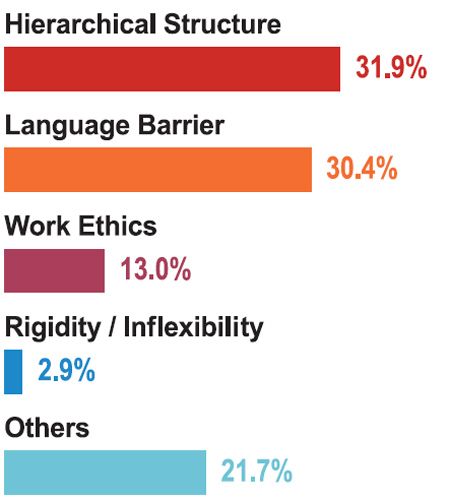
In a recent survey comprised of open-ended questions for 73 foreign business executives from foreign-invested companies operating in Korea, Samil PwC said that respondents indicated the Korea is an attractive market, but a “saturated one that offers unique cultural challenges.”
Survey respondents represented a diverse range of companies with head offices based in 16 different countries located in North America, Europe, Asia and Australia.
About 45 percent of respondents have head offices in Europe, 40 percent in North America, while the rest in Asia and Australia.
“Korean is much more traditional than Western and emerging markets. It can be challenging environment to understand and communicate to get a clear and accurate picture,” the survey summarized.
Although Korea has a strong work ethic and highly educated labor force capable of adapting to changes rapidly, the country lacks human resources with global experience that can communicate fluently in English.
Also, some respondents said that they find it hard to recruit such a talent at senior executive and management levels, while noting that it is also difficult competing with local conglomerates, or chaebol, in recruiting quality engineers.
In addition to Korea’s heavily top-down culture and language barriers stifling innovation and creativity in the workplace, its inflexible labor market makes it harder to hire new employees.
“This results in not only lower levels of productivity but also has the unintended consequence of restricting ability to recruit new employees. An inordinate amount of time was spent dealing with unions and negotiating collective bargaining agreements,” Samil PwC said.
Family-run conglomerates, or chaebol, represent unique attributes of the Korean market that “help facilitate business opportunities” with foreign-invested companies to go beyond borders.
However, a majority of respondents said that the country’s current regulations are mainly set up to protect and favor local chaebol companies.
While just over half of all respondents indicated that their companies were benefitting from Korea’s network of free trade agreements (FTAs), some mentioned difficulties in fully capturing benefits due to lack of proper FTA implementation.
Some of the more attractive features of Korea that were cited by respondents included the “dynamic nature” of the market, while praising Korea’s advanced infrastructure.
The overwhelming majority of respondents do not believe that instability on the Korean peninsula in relation to North Korea has a significant impact on their local business operations, Samil PwC said.