Korean companies worry about quadruple whammy
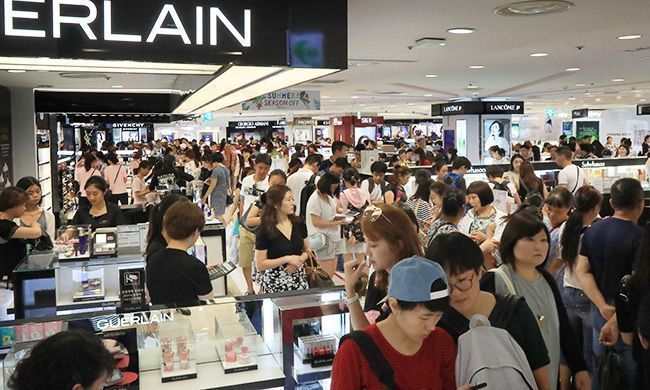
Chinese tourists crowd a duty-free shop in Lotte Department Store in downtown Seoul on Aug. 1. Market watchers worry that Korea’s domestic demand will be hit by its plans to deploy a U.S. missile defense system on its soil, as China moves to impose economic sanctions against the country, hurting sales in the tourism and retail industries. / Yonhap
THAAD factor worsens prospects of already-struggling economy
By Kim Jae-won
Korean companies worry about a quadruple whammy in the latter half of this year as threats are looming over the four major pillars of the economy ― exports, consumption, government spending and investment, analysts said Sunday.
Asia’s fourth largest economy, whose trades are almost tantamount to national output, might worry most about exports due to rising tensions between its largest trade partner, China, over Seoul’s decision to deploy the U.S.’s missile defense system on its soil.
Market watchers said that the nation’s domestic demand will also be negatively affected by its plan to set up the Terminal High Altitude Area Defense (THAAD) system here next year. If China is gearing up for economic retaliation against Korea, it may most easily hurt sales in the tourism and retail industries.
“China will annoy Korea for a long time in a wide range of sectors,” said Lee Jong-woo, head of IBK Securities’ research center. “Cosmetics and entertainment companies will bear the brunt while tourism and other industries will be hit by China’s visible and invisible sanctions.”
Investors are dumping their stocks of Korean cosmetics companies and entertainment agencies which rely heavily on the Chinese market. Shares of AmorePacific, the nation’s largest cosmetics company, dropped to 359,500 won ($323) on Friday, from 436,000 won a month ago. YG Entertainment, a leading entertainment agency in the country, also saw its shares plunge to 32,000 won from 39,500 won during the same period.
Analysts said that the THAAD issue is cornering an already fragile Korean economy, which grew 0.7 percent in the second quarter from three months ago, posting less than 1 percent growth for three straight quarters.
Observers said that China’s potential retaliation is one of two negative factors weighing on personal consumption along with a strict anti-corruption law which will be effective from Sept. 28.
The Kim Young-ran Act bans civil servants, teachers and journalists from being served meals more than 30,000 won, accepting gifts over 50,000 won and taking gift money for weddings and funerals more than 100,000 won from businesspeople and others related to their work.
The anti-graft bill may upset consumption because it involves more than 4 million people, or 8 percent of a 50 million population. In particular, farmers, golf courses and restaurants are likely to be hit hardest.
To boost the sluggish economy, the government announced last month that it will inject an extra budget of 11 trillion won into troubled shipbuilders and other areas, but the stimulus package is pending at the National Assembly as opposition parties are reluctant to approve it.
The Minjoo Party of Korea and the People’s Party are pressuring the ruling Saenuri Party to yield on other issues, such as paying childcare subsidies to municipal governments, on condition of passing the plan. Opposition parties are taking the helm of the majority of municipal governments, including Seoul.
As uncertainties are lingering on the economy, corporations are passive in investing in new businesses, reserving cash in their coffers. That is creating a vicious cycle, leading to weak employment and low wages.
“The equipment investment index appears to have remained in a slump as machinery sales continue to decline,” said the state-run Korea Development Institute in a report. “In the labor market, employment growth in manufacturing declined sharply.”
Experts said that the country needs to find ways to deal with the quadruple whammy.
“The economy is composed of three major domestic factors of consumption, investment and government on top of one external factor of trade. The prospects for the four are not good,” said a Seoul analyst. “We need to do our best to grapple with the gloomy situation.”