3-Way race heats up for railway in SE Asia
Korea, Japan, China vying to win $15 billion Malaysia-Singapore deal
By Kim Jae-kyoung
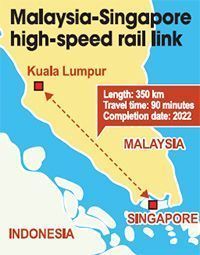
/ Graphic by Cho Sang-won
SINGAPORE — The race for the multibillion dollar Malaysia-Singapore high-speed railway project is heating up with Korea ramping up its efforts to win the project ahead of an international tender to be held early next year.
Germany and France have also expressed their intentions to participate in the race for the railway project between the two Southeast Asian nations, which are expected to sign a memorandum of understanding to facilitate the project in July.
However, market experts expect that the international bidding will be a three-way race as Korea, Japan and China look set for a straight fight for the project in a bid to get the upper hand in the burgeoning Southeast Asian infrastructure market.
The three countries are sending their delegations to Malaysia and Singapore to promote their strengths to win the lead role in the project scheduled to start in 2017 and be completed by 2022.
The 350-kilometer high-speed railway project linking the Malaysian capital Kuala Lumpur and the city-state Singapore, estimated to cost between $12 billion and $14 billion, is expected to cut travel time between the two cities to 90 minutes
Since Sunday, Korea’s Land, Infrastructure and Transport Minister Kang Ho-in is making a four-day visit to Singapore and Malaysia with the Korean delegation to discuss cooperation on the high-speed railway and intelligent transport systems.
Kang’s visit shows Korea’s commitment to the high-speed railway deal. It is the first visit by a minister-level official among the three nations just for the project.
The delegation led by the minister was accompanied by ranking officials from the Korea Rail Network Authority, the Korea Railroad Research Institute, Korea Railroad Corporation (Korail), Hyundai Engineering & Construction, Hyundai Rotem and Lotte Asset Development.
At a meeting with top-ranking officials from the two Southeast Asian nations, Kang stressed that Korea has expertise not only in high-speed railways but also in the development of regions around train stations.
“Unlike other countries, Korea is able to transfer key technologies more easily because the public sector has secured most of the technologies through state-led R&D,” he added.
He explained that Korea has excellent technologies that are able to minimize maintenance costs not only in the construction stage but also in the operational stage.
“However, it is too early to say how much we will share because details of agreement between Malaysia and Singapore have yet to be reached,” Kang said.
According to the European Railway Agency’s data provided by Korail, Korea ranked top in high-speed railway safety, with the accident rate per 1 million km standing at a low of 0.073 in 2014, followed by Italy at 0.09, the Netherlands at 0.119, Germany at 0.166 and France at 0.188.
“Korea has been operating a high-speed railway for 10 years. We have developed technologies through state-led R&D and most production takes place in Korea,” Choi Yong-kyun, executive vice president of Total Rail Systems at Hyundai Rotem, said.
“Now we have secured our own technologies. Technologically speaking, I can say that Japan is a bit better known to the world but there is little technology difference,” said Choi, who is part of the Korean delegation.
Hwang Seung-soon, senior executive director of Korail, also said, “Europe promised to transfer technologies to us but it was not carried out properly. So we have developed and fostered our own technologies almost independently through trial and error.”
The Korean government is currently running an information center in Malaysia to promote Korea’s high-speed railway system and plans to hold a symposium on its high-speed trains there in July.
Intense rivalry
China and Japan have also stepped up efforts to take a lead in the bidding race for the first high-speed railway project in Southeast Asia, by teaming up with their private sectors.
China is seeking to gain the edge through the state-owned China Railway Group, a high-speed railway operator, which plans to invest $2 billion in property development in Kuala Lumpur.
In late May, the Chinese delegation led by China Railway Corp. visited Malaysia to pitch their strengths in the railway sector, especially the high-speed railway project.
In March, The Singapore-based The Straits Times reported that Chinese Premier Li Keqiang wrote a personal letter to Malaysia Prime Minister Najib Razak reiterating Beijing’s commitment to its investments in Malaysia and showing a deep interest in the project.
Japan is counting on its safety record to win the contract.
Japan held a symposium in late April in Malaysia to make a safety pitch for the high-speed railway contract by showcasing Japan’s Shinkansen technology, which it claims has a perfect safety record over its 51-year history.
“We are confident that we would be able to contribute to the Malaysia-Singapore rail project with our experience and technology,” Yuji Fukasawa, executive vice-president of East Japan Railway Company (JR East) said.
During his recent visit to Japan, Malaysia Deputy Prime Minister Ahmad Zahid Hamidi said that his country will focus on how beneficial each country’s offer is to Malaysia and its people, not just on pricing and specifications.
“The best offer is not based on pricing and specifications, but also on the benefit to the government and people,” he was quoted as saying by a Malaysian daily.
The aggressive move by the three Asian economic powerhouses comes as part of their efforts to get the upper hand in the rapidly-growing Southeast Asian infrastructure market following the launch of ASEAN Economic Community (AEC).
Since the Malaysia-Singapore high-speed railway deal is the first mega-size project in the region, whoever wins the lead role will seal an advantage in strengthening their foothold in the burgeoning market.
According to a report by auditing company KPMG, an estimated $60 billion is needed per year until 2022 to fulfill all the infrastructure needs of the region. The energy and transport sectors are expected to make up the biggest proportion of this investment.