Everyone's worse off in aging society
By Kim Tong-hyung
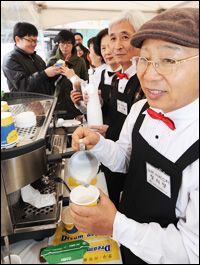
Retirees undergoing training as baristas in a state-supported job program offer their brews at a job fair in Seoul. Surveys show the majority of older people intend to work past the traditional retirement age to avoid an acute drop in living standards. / Korea Times file
Korea faces an aging population time bomb and there isn’t much hope that the eventual detonation will leave its teeth intact.
The majority of workers aged over 50 expect to work past retirement age because they feel increasingly forced to do so in order to survive financially. Too bad the decaying labor market has baby boomers going bust and people over 60 sinking into poverty after even being rejected from menial jobs, official figures show.
Improving labor participation would be critical to beset the impact of a workforce aging in dog years, but that is proving to be difficult in a country that has a modern economy but also the highest levels of gender apartheid.
The pressure on the younger generation workers is becoming immense: Within a decade, there will essentially be two retired people for every person in work, compared to the current three-to-one ratio, according to a finance industry study.
Building a dynamic workforce is critical. But further discouragement comes from the millions of graduates and school leavers bearing the brunt of the downturn, touching off concerns over a generation blighted by joblessness.
``The employment situation of old people was hit hardest by the downturn of 2008-2009. The majority of workers are retiring when their financial readiness shows they can’t afford retirement, which throws them into a vicious cycle because this economy has been failing to create enough jobs for them,’’ said Park Jong-kyu, a senior economist from the Korea Institute of Finance (KIF).
``The unemployment rate for old people is rising faster than those among other age groups, and considering the increasing demand for work among them, there has to be a policy approach to address this.’’
The unemployment rate among people over-60 people reached 2 percent last year, nearly doubling the 1.1 percent measured at the end of 2008, indicating an increased demand for work and a lagging supply of jobs. Changes in the youth unemployment rate, for people aged between 15 and 29 which was around 7 percent last year, were less dramatic.
``Korea’s proportion of people between the ages of 65 and 69 is second highest among the states in the Organization for Economic Development and Cooperation (OECD). The high unemployment rate, therefore, indicates the greater threat of an acute squeeze on living standards and increased poverty after retirement,’’ Park said.
``The situation is harder for women. There are an increasing number of women over 60 who want to work because they need the income. However, unemployment among women of this age group is significantly higher than it is for men. ’’
The job market is just as harsh for women over-40, evidenced by a record 6 million of them who stayed at home last year working as full-time housewives, according to Statistics Korea, the national statistics office.
The significant increase in the number of those aged 60 and over _ the majority of them woefully unprepared for life off a payroll _ places a growing financial burden on workers paying tax to support the elderly.
Numbers from Statistics Korea show that there was one retired person for every six at work last year. However, Kang Sang-hee, a pension researcher for Mirae Asset, claims the government data softens reality because it is based on the official definition of the working age population _ people between the ages of 15 and 64.
Considering the high rate of students opting for college education, the average Korean doesn’t acquire the financial ability to support a family until in his or her mid-20s. And considering retirement ages at companies, economic activity of people in their late-50s or older is very low.
Kang would rather focus on the burden of the ``core productive population,’’ or those between the ages of 25 and 49. There were just over three workers in this age group for one retired person in 2012. The ratio is expected to turn 2-to-1 in 2023.
``This could be the seeds of a serious social problem and generational conflict, particularly in issues over taxes,’’ Kang said.
Korea’s headline jobless rate stood at 3.2 percent in 2012, down from 3.4 percent in 2011, prompting policymakers such as Strategy and Finance Minister Bahk Jae-wan to declare that unemployment is under control.
Yet closer examination of government statistics reveals an uglier picture of employment than many imagine.
The 750,000 or so people officially listed as unemployed are dwarfed by the 16 million deemed economically inactive ― neither in work nor seeking employment. This means that 40 percent of the country’s working age population above the age of 15 is sidelined from the labor market.
And more than 80 percent of the new jobs created in the past year went to people over 50, confirming that the unemployment rate has been softened by menial jobs.
There has been an alarming rise of ``discouraged’’ young people who have given up because they don’t believe there are any jobs available. The struggles of people in their 20s and 30s are matched by the perils of millions of middle-aged Koreans who are forced to start their own businesses out of necessity after being sidelined from the labor market.
A recent study showed that nearly half of self-employed businesses, such as coffee shops, fried chicken pubs and convenience stores, derail within three years and more than 75 percent of them fail to last a decade.
The intersection between low-income earners, people over the age of 50 and the self-employed has been growing rapidly and critics fear this could prove to be ground zero if there is an explosion in the country’s financial stability.