Foreign business leaders' wish list
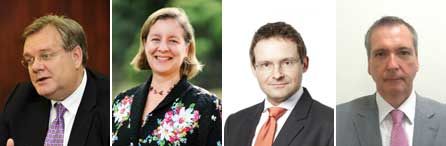
Jeffrey Jones Lawyer at Kim & Chang
Park asked to ensure consistency in rules, avoid repeat of Lone Star case
By Cho Mu-hyun
Foreign business leaders are calling for President-elect Park Geun-hye to place top priority on ensuring consistency in regulations and swiftly implementing free trade agreements (FTAs). They also advised her not to allow another Lone Star case.
The suggestions were made during interviews by The Korea Times with several foreign business leaders here who are pinning high hopes on changes Park will bring to a Korean economy that is expected to face slow growth and a scarce supply of jobs next year.
As Korea has been vocal in boasting its increased global recognition, the foreign business community hopes the government will take action to back it up and create a wish list for the President-elect of the ruling Saenuri Party to address.
Jeffrey Jones, an international lawyer at the nation’s largest law firm Kim & Chang, said the main priority for Park should obviously be improving the economy, and noted directly related problems to resolving that will achieve this.
“When the domestic economy suffers, foreign businesses suffer. The first thing is to create an environment in which jobs can be created because the difficulty in finding jobs, particularly for young people limits consumption by ordinary people,” said Jones. “Because they feel a sense of uncertainty for the future, they don’t consume, and the absence of consumption hurts businesses.”
The former chairman of the American Chamber of Commerce in Korea (AMCHAM) said the foreign business community wants a “consistent enforcement of existing rules.”
“Very often they say deregulation. More than that is the necessity of predictability. A consistent enforcement environment so that businesses know what the rules are and how they will be applied, can help them structure their business activity accordingly,” he said. “You get greater predictability through long-term enforcement, clarity and transparency.”
Thilo Halter, the chairman of the newly organized European Chamber of Commerce in Korea (ECCK), expressed a similar view to his American counterpart in a congratulatory letter.
While emphasizing that “Europe-Korea relations is one of the strongest and healthiest partnerships based on respect and mutual understanding,” he said. “There are still issues that will be talked about and discussed.”
Halter said the European business community often wants to “understand more clearly the regulatory environment in Korea as well as see more predictability for regulations.”
David Kwon, information management solution provider CommVault’s country manager for Korea, wanted fair competition and a laissez fair policy for the development of the information technology industry which candidates have admitted would be one of the country’s growth engines.
“Lessening regulations must happen. Fair competition will lead the Korean IT industry’s globalization. I hope that during the next administration our information index (the OECD’s stenography for countries’ telecommunications maturity) skyrockets,” he said.
Brian Hopkins, a professor at Sejong University’s graduate school of business, was more specific in some issues Park should clarify, especially the FTA between Korea and the U.S.
“I would assume the Korean government continues implementing the free trade agreement. There were talks by the other party to revoke the agreement. That is a note of concern,” he said. “I think so far people are thinking that it is working stretching business ties and Korean businesses.
“Of course, as some have mentioned, it is benefiting certain industry over others, such as automobile parts. But I think it is important it the long-run.”
Since the implementation of the FTA in March, it has received a mixed reception.
AMCHAM President Amy Jackson, following the presidential election also highlighted the importance of the Korea-U.S. FTA saying, “Once the two countries’ economic cooperation is strengthened through the KORUS FTA, the relationship between the two countries will be truly enhanced by the solid foundation built of three pillars comprised of politics, military and economy.” The latest pillar is an economic connection built by the FTA, said an AMCHAM spokeswoman.
Hopkins also pointed out that he expects that banking and finance businesses would absolutely not want a repeat of the Lone Star sale, “a nightmare I think that really hurt (the reputation of) the Korean business environment.”
Kwon agreed. “The KORUS FTA will increase the maturity of the Korean IT industry, and Korea must grow its competitiveness within that framework,” he said
Riot Games’ Managing Director of Asia Jin Oh expressed hopes of strong interest as well as support for the game market that “is now an industry and a cultural phenomenon in its own right that is loved by everybody.”
“A turning point always has new possibilities so I think it is optimistic. Not only online games but the growth of mobile games is also noticeable now,” he added.
The Korean government has been divided in it approach towards the emerging market despite many noting it has grown large enough to draw level with local pop music scene, even though majority of its policies limits companies’ channels to sell their titles.