GS Caltex focuses on eco-friendly business
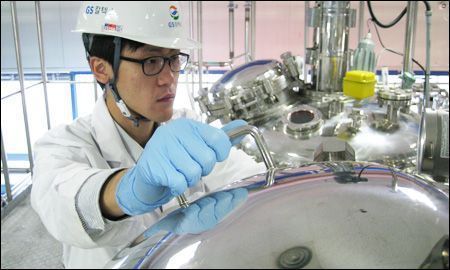
A GS Caltex engineer examines a facility producing biobutanol at the company’s research center in Daejeon in this recent photo. / Courtesy of GS Caltex
By Park Si-soo
GS Caltex (GSC), Korea’s second largest oil refiner, is stepping up efforts to develop eco-friendly energy sources. The latest achievement is the development of core technologies to produce biobutanol, a renewable alcohol.
The new energy source is largely unknown to the public but a growing number of companies are pushing to develop their own formulae for the bio-fuel that is emerging as a next-generation, eco-friendly energy source along with biodiesel and bioethanol.
Biobutanol is made from a variety of conventional feedstocks such as sugar cane, sugar beet, corn, wheat, and cassava among others.
Since 2007, GSC has conducted extensive research and studies in cooperation with domestic universities and developed dozens of new technologies for biobutanol production. It owns nearly 40 patented technologies.
Officials said the biggest achievement of these efforts has been the development of a microbe that helps produce highly efficient biobutanol. This technology was developed in a joint study with the Korea Advanced Institute of Science and Technology and was published in mBio, a peer-reviewed journal published by the American Society for Microbiology, on Oct. 23.
The firm also succeeded in developing ways to produce three times more biobutanol than with previous methods, while saving costs of up to 70 percent.
“We see biobutanol as a new growth engine,” a GSC official said. “We will continue to make investment in the industry to become a leading manufacturer.” The official said the company is seeking ways to produce biobutanol using abandoned wooden products and other uneatable biomass.
The biggest advantage of bioethanol is that it can be easily added to conventional gasoline due to its low vapor pressure, which means the new fuel is workable in existing vehicles and engines. Another advantage is that the fuel is less susceptible to separation in the presence of water than ethanol/gasoline blends, and therefore allows it to use an existing pipeline and other distribution infrastructure without modifications in blending facilities, storage tanks or retail station pumps.
Butanol is used worldwide, with current global demand exceeding 1.2 billion gallons per year and is valued at over $6 billion annually. Butanol demand is forecast to reach around 200,000 tons in 2015, according to ICIS, a petrochemical market information provider.