Park Jae-hyuk is a seasoned journalist who has provided comprehensive coverage of South Korea's corporate dynamics, economic policies, industry challenges and the global positioning of Korean companies. Based on the articles he has written since joining The Korea Times in 2016, his investigative approach has helped readers understand corporate governance, economic trends and business strategies shaping South Korea’s economy.
Card issuers face tough road ahead
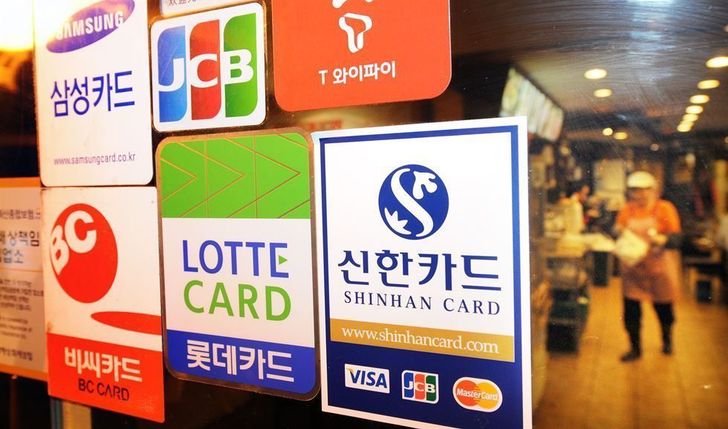
Stickers show credit cards that can be used at a restaurant in central Seoul in this file photo. / Korea Times file
By Park Jae-hyuk
By Park Jae-hyuk
The nation's card issuers will suffer worsening profitability during the second half of 2019, due to the expected hike in their default rates and the planned return of transaction fees to small business owners, market analysts said Monday.
The card firms have minimized revenue loss by cutting costs, in the face of the government's policy to reduce their transaction fees.
Analysts, however, said the companies will face more difficulties in the second half, because of additional unfavorable factors waiting for them.
During the first half of the year, the combined net income of the country's five card issuers ― Shinhan, KB Kookmin, Woori, Hana and Samsung ― was 709.6 billion won ($599 million), down 7.1 percent from a year earlier.
Hana suffered the sharpest decline during the period, as it posted a 33.7 billion won net income, a 34.7 percent drop year-on-year.
Kookmin posted a 146.1 billion won net income, a 12 percent decline from a year ago, and Shinhan posted 271.3 billion won, a 3.8 percent drop from a year earlier.
Woori and Samsung showed the smallest decreases, posting 66.5 billion won and 192 billion won, respectively, down 1.6 percent and 1.2 percent from a year earlier.
Analysts said the earnings of the companies ― except for Hana ― were better than expected.
“Despite the reduction of transaction fees, a profit-oriented management strategy led to the better-than-expected earnings,” Hyundai Motor Securities analyst Kim Jin-sang said.
The companies attributed the result to their cost-reduction efforts.
Amid a deterioration in profit margins caused by the government's fee reduction policy, card issuers have reduced their sales staffs.
Data show that 849 salespeople were let go at seven card firms ― Shinhan, KB Kookmin, Samsung, Hyundai, Hana, Woori and Lotte ― in the first half of the year, shrinking their numbers to 11,856 in May from 12,607 in December.
Fifty-three sales branches of card firms were also closed in the first three months of the year to cut costs. The seven firms had 216 branches as of the end of March, down from 269 in December.
Despite those efforts, analysts say the outlook for the card-issuing industry will be bleaker.
“The return on assets of card issuers have continued to decline over the past 10 years,” a NICE Investors Service analyst said. “The profitability of card issuers will become worse during the second half of the year.”
Analysts cite the expected hike in default rates resulting from the lingering economic slowdown as the main reason for the gloomy outlook.
The Bank of Korea, which slashed Korea's 2019 growth outlook to 2.2 percent from 2.5 percent, hinted at a further cut in growth outlook amid the trade feud with Japan.
According to the analysts, card firms will have to keep more money in reserve in case the default rate rises, as this will lead to higher costs.
The planned return of transaction fees to small business owners is another unfavorable factor for card issuers.
Because the government ordered card issuers to cut transaction fees for small business owners who opened their shops in the first half, card firms will have to return up to 57 billion won to them by Sept. 11.