CONTRIBUTION Perspectives on investment in K-content
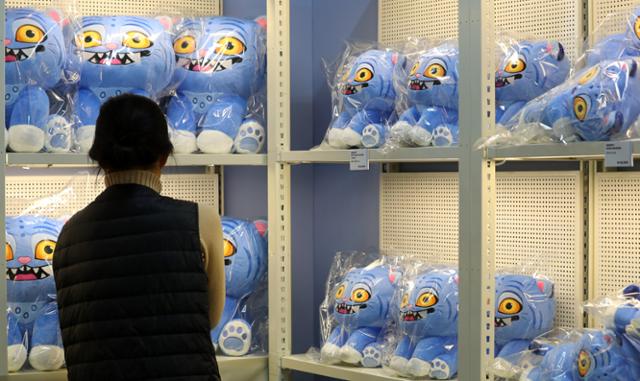
A woman looks at character dolls from "KPop Demon Hunters" at a pop-up store in Seongsu-dong, Seoul, Dec. 3. Newsis
Among the Korean cultural products that raised the country’s profile this year, the most outstanding success was undoubtedly “KPop Demon Hunters.” Netflix is reported to have earned more than 1.4 trillion won ($970 billion) in direct revenue from the film alone. At the same time, souvenir sales at the National Museum of Korea — buoyed by the popularity of the film’s Korean folklore-inspired characters — surpassed 35 billion won, and the number of foreign visitors to the museum has increased significantly. Although “KPop Demon Hunters” is not a Korean production, it clearly demonstrated just how powerful the ripple effects of K-content can be.
Choi Youn-jin
From that perspective, investment in K-content remains disappointing in many ways. Because funding is still largely focused on single projects and individual titles, even when a work succeeds and its impact spreads to products, tourism, food, fashion and more, there are limits to how fully those results can be captured. A report released on Dec. 26 by Startup Alliance, titled “Limits of the K-Content Investment Structure and the Potential of IP-Based Investment,” points out this issue explicitly. According to the report, even though K-content has achieved global success, it is still viewed as a highly volatile sector, preventing stable and sustained investment.
This creates fundamental constraints on nurturing the content industry. As the report notes, investors tend to concentrate on relatively stable conglomerate-affiliated content businesses or platforms, leading to a skewed investment structure. As a result, the majority of companies struggle to secure steady funding and remain small in scale. According to the Korea Creative Content Agency, as of 2023, 88.6 percent of content companies recorded annual sales below 1 billion won.
In such conditions, it becomes difficult to build an industrial ecosystem capable of continuously expanding K-content’s global influence across diverse sectors. To overcome these limits, perspectives on content investment must change. Rather than restricting returns to content revenue alone, the vision should expand to draw broader spillover effects across multiple industries using content as a catalyst. Yang Ji-hoon, associate research fellow at the Korea Culture & Tourism Institute and author of the report, argues that “related industries must be brought in as stakeholders within the content-investment structure,” adding that it is necessary to design mechanisms that allow them to participate by granting priority rights to use certain portions of the content IP.
The government also needs to take a more active role in supporting the content industry, as it plays a major part in elevating national prestige while contributing to the broader economy. Lee Ki-dae, head of Startup Alliance, noted that “although K-content enhances Korea’s national standing, concerns over investment-return risks restrict funding for creators,” and suggested that “public-finance support deserves consideration.”
Data shows that when Korea’s content exports increase by $1 million, national brand value rises by $410,000, and when content exports grow by $100 million, related consumer goods exports increase by $180 million. From this standpoint, the government should reassess support for the content industry from a fresh perspective.
The writer heads the Startuplab section of the Hankook Ilbo, where he covers the IT and startup sectors. This column from the Hankook Ilbo, the sister publication of The Korea Times, is translated by a generative AI system and edited by The Korea Times.